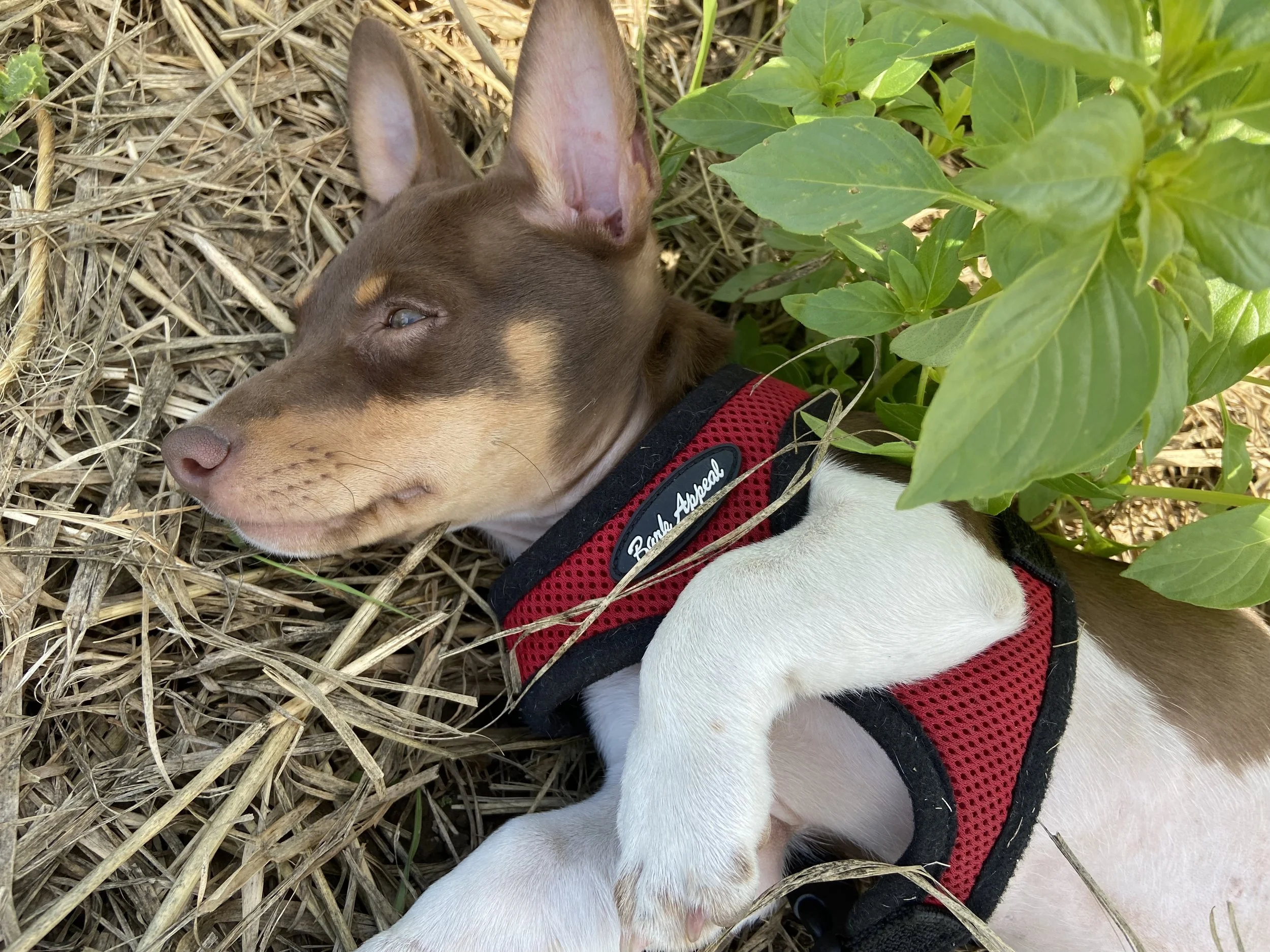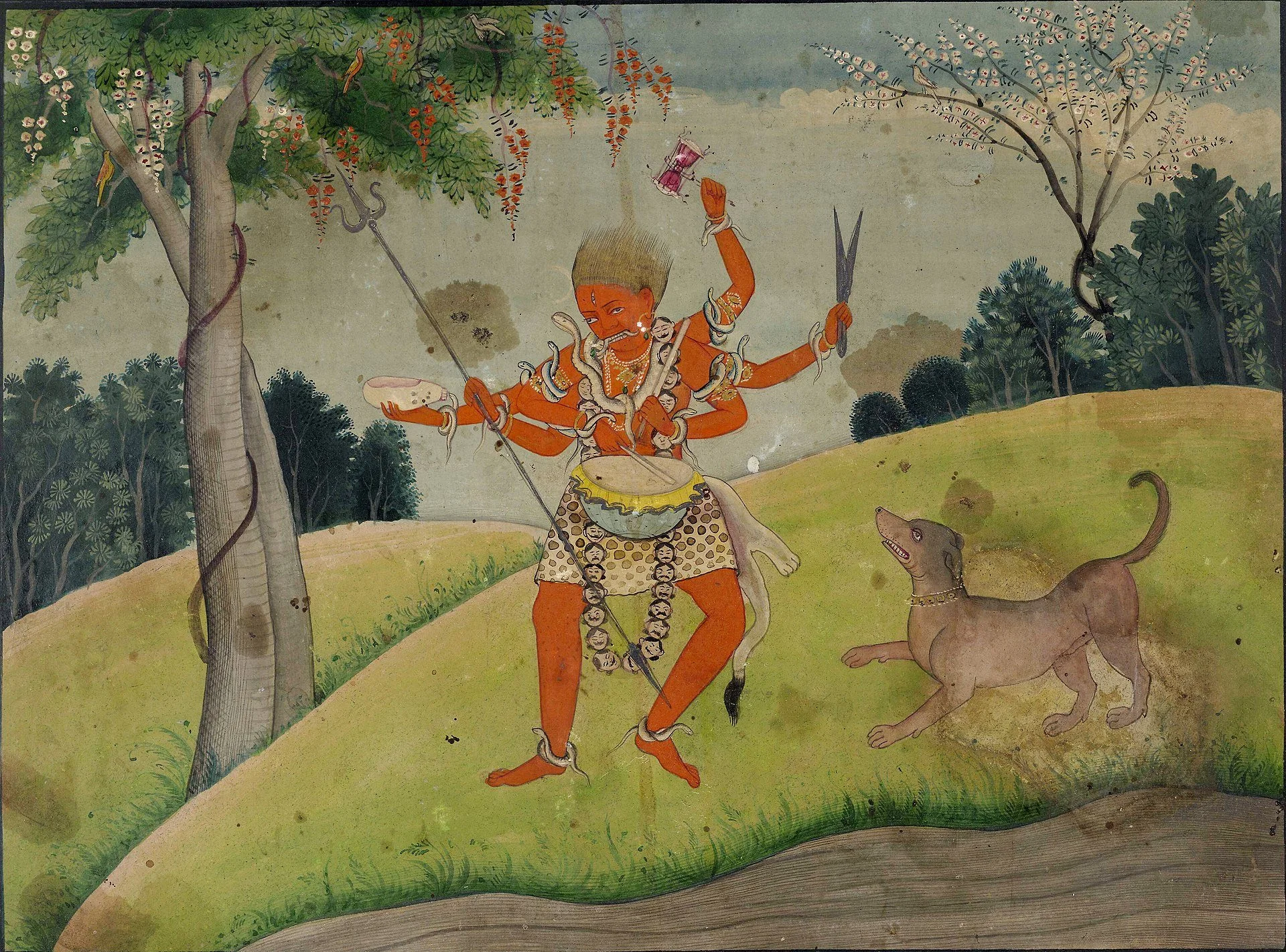
Śiva as Bhairava with a dog. Unknown artist.
Blue
•a dreamstory•
i
I was feeling good. It had been a great run; the type of run that makes you feel like a part of yourself is floating up above your body, performing swoops and dives in the rarified air out of pure joyfulness while the other part of you (the greater part, the denser part) plods along exhausted, subdued, hardly able to get in the way anymore.
So when I spotted a familiar hunched, boyish form making its way slowly down the sidewalk next to a dog with speckled blue fur, I picked up the pace instead of looking for a way to avoid her. I’m not usually one for chatting with neighbors.
“Hey, Blue!” I sang, as I always did, as I approached; “Songs are like tattoos, you know!” I scratched Blue behind the ear, and he pressed against my legs in greeting, then plopped down on his haunches to wait for us to chat. He was an oddly serene animal. A Blue Heeler, Casey had explained to me. Fur of black and white mixed together, so that it only looked blue. But I didn’t believe her. I knew what blue looked like, and that was it.
And what was color anyway, but a look?
“Hey, Casey,” I said, smiling at her. “How’s it going?”
“Oh, you know,” she said, which clearly meant bad. This wasn’t unusual. I often got the impression that she was just on the verge, teetering on a ledge over which, if she finally toppled, the neighborhood would have something to gossip about for a long time to come.
I didn’t find a way to redirect the conversation before she could elaborate.
“I’m losing clients,” she told me. Casey was a therapist, which amazed me every time I recalled it.
“Oh no, why’s that?” I asked, automatically. My self was still twisting and twirling in the air above us. The fall evening was vibrant with color: autumn leaves; sky; fluffy cartoon clouds scudding along; the vibrant blue of Blue. From up there I could see everything with perfect clarity, for miles and miles. My self looked and looked—entered a veritable frenzy of looking—while the dense part, which was a simple, material thing I’d stitched together out of scrips and scraps gathered from my surroundings; snips, and snails, and random detritus—stood patiently rooted to the earth, listened to Casey.
“Well they all want to talk to me about what’s going on politically—” Oh no. “—and, I mean, I just don’t know what to tell them.”
I could tell she had leapt right in; there was no getting in the way of this now, and despite myself I felt the two parts of me settling down and coming together again. And when they were yoked together like that, the denser part always won. I was feeling tired. The run had worn me out.
“I mean, it’s like, yeah: it’s just as bad as you think it is. Worse! I mean, they’re abducting people out of cars, out of their apartments, off the street! They’re ramming people’s cars in intersections then pulling them out through the window and sending them off to concentration camps! They’re making it illegal to teach about racism, or gay people, or slavery! They’re cutting food stamps and giving fucking tech CEOs trillion dollar pay packages! They’re testing atom bombs again! They’re starting wars! And don’t get me started on the climate! Like, what the fuck! You should be scared; you should be fucking depressed!”
I nodded, beginning to see why she was losing clients. Even the clients who hadn’t noticed anything off about Casey before wouldn’t be able to miss this.
“It’s just, like…why am I trying to make people feel better about all this? I mean people need to be mad about it. Sometimes I feel like therapy is just brainwashing…”
I glanced down at Blue, who looked up at me with sad eyes. Eyes that, at first, seemed to simply be saying here we go again. But then after the first impression, I caught something deeper in them. How could a dog have a look like that in its eyes? It was deep, and mournful. The wisdom of it; the way it seemed to fully expose itself to all the sadness of the universe—completely, without reserve. I shivered.
Then I laughed, and pointed. “Look, Blue’s sad about it, too!” I said.
Casey looked surprised, then glanced down at Blue. Then she seemed to recall herself, and said, “Oh yeah, poor guy. He’s probably heard me talk about all this one too many times.”
I felt bad for Casey. She seemed totally lost. Disconsolate.
There was a silence that was too angular to fit into the slot it was intended for.
“Well, sorry to hear it’s been rough at work,” I said. “I hope it gets better.”
“Yeah, thanks,” Casey said, brightly. “It was nice to see you, Lucas!”
I jogged the final block home and burst with pleasure into the warm air of the living room, feeling the naughty thrill of an escape. It was getting nippy out, and I was covered in sweat, so the heat was a relief. I drew the blinds in the living room and stripped out of my running shorts and t-shirt, rolled out my yoga mat, and started to stretch, naked on the floor. Stretching could loosen the bonds between the good part of me and the heavy part just like running did. But it wouldn’t let the light part free to dance above me again. Stretching wasn’t that powerful. That only happened after serious exertion, or sudden, intense emotion. That was over for tonight, thanks to Casey.
It wasn’t that I disagreed with her about the state of the world. I didn’t. But that wasn’t the annoying part about it. This was Madison. We all agreed. So why did we need to talk about it? Especially on a beautiful October evening when there were so many positive feelings to be snatched from the gaping maw of life?
After I was done stretching, I went into the bathroom and turned the shower on. I looked at myself in the mirror while I waited for the water to heat up, liking what I saw. My new, brutal leg day routine was really starting to pay off. If I looked back over my shoulder and arched my back just so, the curve of my lower back into my butt and then down to my thigh was amazing: a flowing, smooth curve. Like a painting or a statue. But not the kind where the artist seems to be trying to portray people the way they actually look. More like an art deco statue of Hermes taking off in his flying shoes. So hot. I thought about getting my phone and taking some pictures and sending them to Jimmy. I liked the thought of him popping a boner in his scrubs at work looking at my nudie pics. But my phone was all the way in the kitchen, so I would have to do it another time.
I missed Jimmy when it was one of his evenings to work. But it also wasn’t that bad to have the house all to myself. It was nice either way. Reflecting on that made my chest fill up with a kind of elation: life was so good, even if the news was always bad. It was that disjunction that often took me aback. The world was bad, no question—but my life was wonderful. We had this cozy house, and each other, and stable jobs. Evenings that scintillated with life. And my pecs and my biceps, which were looking hot as hell. Poor Jimmy, checking his phone in the break room and not having a picture of this waiting on it. But the kitchen was too far to go just for that.
As I stepped into the shower, the steam and heat seemed to release something in me: a memory that had been forming the entire time I was admiring my ass and my arms. Luke Robertson’s butt. The two pale, full moons of it hanging in front of my face the time I had pantsed him in the driveway after we swam in the pool at my parents’ house when we were kids.
And then the annoying look he had given me after he succeeded in pulling his trunks back up and turning around: a look totally wretched and terrified. Brokenhearted. Just so completely pathetic, and he had whined, mewling: “What if someone saw?”
Idiot. As if he didn’t know very well that that was the whole point. That was the entire joke.
I shuddered under the hot water. What was wrong with me, thinking something like that about a poor, bullied eleven-year-old? Why had I been so mean to that kid, anyway? It made me feel ashamed every time I thought about it, but at the same time, it was just kid stuff, right?
Although I suppose nowadays it wouldn’t be seen that way. Doing something like that would probably get a modern-day kid thrown in jail, or exiled from the internet or something. At the very least relegated to a purgatorial existence in the “manosphere”.
Maybe I had bullied him because we had the same name.
No, that wasn’t it; that was why we were friends in the first place. Because it was funny when someone said, “Hey, Luke,” and we both said, “What?”, the two of us being so different.
It had been funny, at least, until it became annoying. And then in high school I started making everyone call me Lucas. And I was Lucas to this day.
It was something else. The hot water was starting to warm me up in my core and part of me was sinking down to a place where memory was much closer. It was because there was a kind of glee to it—to the cruelty. A definite positive feeling; something I felt like I needed at the time. I had to have it, and so I hadn’t really had a choice.
But it also hurt me, even then.
It was like when you have a sore in your mouth, and you can’t stop jabbing at it with your tongue even though it hurts, because there’s a great delight there—so close—buried just underneath the pain, if you could only reach it…
And it was also, I remembered, because of his mom. In fact, I suddenly realized that she was the whole reason I was thinking about Luke right now in the first place. Because Casey reminded me so much of her: Ms. Robertson, who taught us biology in the fifth grade. My favorite teacher despite the fact that she was Luke’s mom. She was so calm and serene, and sad. Her husband had died a long time ago. Luke hardly remembered him. But it was like part of her was trapped back there, and so she was sad all the time, even when she was telling us about mitosis and meiosis, which always got her going, a light of excitement playing in her eyes under her boyish haircut. She was a tiny lady, just like Casey, and sometimes if you just glanced at her in the hallway you could mistake her for one of us, a fifth grade boy.
How could someone have any problems when they had a mom like that, and not even any dad to worry about? If I hadn’t had a dad my life would be so easy. At least that was how I felt at the time, and that was part of why I resented Luke even though we were friends. Part of why I helped Alex hold him down while we performed Chinese water torture on him, opening the faucet of the bathtub just enough to tap, tap, tap on his forehead.
After that he had been shivering and had a hollowed-out look in his eyes that made you think of a ghost blindly performing the circumstances of its death over and over again for centuries. It made something smolder in me, blackening and curling in on itself in pain. But it also annoyed the fuck out of me, because it seemed so melodramatic. It was just a joke, come on.
Suddenly, though I hadn’t even soaped myself off at all and had just been standing there under the shower staring blindly in front of me as I rehearsed these memories, I just couldn’t be in the shower anymore. I was too exhausted.
Sometimes the lighter part of me decided it was going to show the dense part what density really meant. Then it would sink down, and down in me, sinking and shrinking until it was just a single point. And then it was like all the matter in the universe held its breath in that single point, and having it there inside me was unbearable because the impacted force of it tore at everything else with a terrible power. I turned off the water, staggered out of the shower. I dried myself off perfunctorily on my way to the bedroom. I had never been so tired before. I hadn’t even eaten dinner yet. It was barely getting dark.
But I knew I had to sleep. Right now. As an escape, but also because I had a strong feeling that I had missed something. Something had been unduly ignored, and I needed to remember it. Sleeping was how I would remember. Sleeping and dreaming. Somehow I knew that.
I collapsed onto the bed, still naked, and the last thing I remembered as night opened its maw to swallow me were those eyes: dulcet; fully mournful; wise beyond the wisdom of any man.
ii
They were playing Rhapsody in Blue and we were missing it. I could hear it echoing, zany and madcap out over the entire quad. There was no hope getting anywhere on time when you were dragging Luke Robertson along with you everywhere you went. He was so slow. Going somewhere with him felt like walking in quicksand.
That was exactly how I felt, crossing the quad. The sky was searing blue on the verge of darkening into evening; the air was crisp; leaves of yellow and red fluttered in the brawny illumination of the sun. It all felt so familiar to me, like a lover curled up in the crook of your arm so that there’s a zone of indetermination between his warmth and your own. And yet, despite all that, Luke was behind me and so each step sucked me deeper into the pavement of the sidewalk we were walking along so that it was like I was moving in slow motion or wading through treacle. Not to mention the fact that we had to dodge the cops who swarmed and clustered here and there on the green, patrolling with assault rifles in hand, not hesitating to smash the butt of their weapons into the faces of any students who got too close. Maybe it was the music that was setting them off. They hated classical music. If they knew where we were headed, we would certainly be a target.
I adjusted our course to give a wide berth to a melee that was happening near the building where the conference was going on. Six or seven cops beating a group of poets who were all collapsed in a pile of limbs on the grass. They were hitting them with these odd batons that threw out electrical sparks with every bonecracking impact. I could see the cops’ point, honestly: they looked extremely annoying, with their cardigan sweaters, and their berets, and their horn-rimmed glasses. But give them a break. That was just what they liked. Everybody has a thing.
When we got into the building, Luke’s quicksand influence lightened up a little and I was able to make it up the stairs fairly quickly. And there it was, at the top of the stairs, a banner that hung above a pair of double doors, reading Conference of Parties. Better late than never. I hoped Ms. Robertson wouldn’t be too annoyed with us.
The performance was just ending as we slid through the doors and quietly stood against a wall. The musicians were in the middle of the room, and the smattering of audience members were gathered around them on couches and chairs. It wasn’t until we were in the room and watching that I actually glanced over at Luke, and was surprised to see that he looked really old. Like positively elderly, with white tufts of sparse hair sticking up here and there at odd angles, deep creases and wrinkles turning his face into a topographical relief, a body so thin and desiccated that he reminded you of an overgrown cricket. He was so frail that he was wobbling just standing there. No wonder he was so slow.
I caught sight of Ms. Robertson across the room at her desk. She looked the same as ever, like a fifth grade boy. It was funny, Luke being so much older than his own mother.
She seemed to think it was funny too, and cast an ironic grin across the room at him as if she found it positively endearing, this regalia of age that he had assumed. The intimacy of the glance immediately caused flames of envy to lick at my spine, and these turned into a real conflagration when I noticed the way Luke looked when he saw her expression. Her smile seemed to knock quite a few years off of him. His skin was still papery and wrinkled, but now it wasn’t quite so translucent. His hair was still white, but it had more body to it now. He no longer wobbled, though his back was still hunched and deformed with the weight of years.
There wasn’t anything for me to do about it, though. You can hardly bully an old man. At least not without coming across as a real jerk.
So I turned my attention to what was going on in the room. The orchestra that had been playing before had cleared out, and now a regal young woman was taking her place at a harp in the center of the room. There were just a handful of other musicians gathered around her on chairs, each holding an exotic instrument. They were tuning strings and performing mic checks, the inward-looking and percussive business of preparing for a performance. There was an air of expectation in the room. The woman at the harp had a beautiful dress, and a beautiful face, and I felt sure that the music she made would be beautiful, too.
While we waited, I glanced around, and noticed that the walls were covered in old, Polaroid photographs. One in particular caught my attention. I walked over to it, and looked closely. It was of a dog with blue speckled fur lying on his side while several puppies sucked at his teats. Seeing the picture seemed to remind me of something: something that I urgently needed to remember. But the urgency was all that came. The memory itself stayed beyond my grasp, and its presence just beyond the radius of consciousness seemed to taunt me. I stared blankly at the dog in the photograph for a second longer, trying futilely to fish the memory out of the oblivion it occupied. I looked at his eyes, which peered at the camera over the scrum of puppies. They seemed so sad. I shivered. Then I turned away, giving up on the memory, whatever it was.
The air in the room was abuzz with the type of clangor that always fills a concert hall during an intermission, but I couldn’t help but notice a certain antagonistic flavor to the general murmur. Looking around, I noticed that the audience members were all looking down at their programs with expressions of consternation, or even rage. I picked one of the programs up from the floor, and took a look myself. After Rhapsody in Blue, the next piece was meant to be a three hour long composition for jazz harp. This seemed to rile the crowd to the point of mutiny. They didn’t have the patience for this type of music, and they were demanding something more entertaining. “Let’s just watch Netflix!” someone called out, and a general cheer went up around the room. The regal woman at the harp paused, uncertain; graceful fingers hovered next to the strings.
I glanced over at Ms. Robertson, knowing that this would be a blow to her. It seemed worse than I would have imagined. She looked positively devastated. All the years of sadness that she always seemed to hold inside of herself came pouring out, and she wept.
And Luke, that little bastard, had somehow made it all the way across the room without me noticing. He was standing by her side, comforting her. Now he could move fast.
Which actually sort of made sense, I realized, because it seemed that the activity of comforting his mother had caused even more years to slough off him. Now he seemed no more than late middle-aged. His hair still had some brown to it, though it was predominantly gray. He was sturdy and hale, if still his awkward and nerdy self, and I could tell that Ms. Robertson was glad to have his arm around her shoulder.
Feeling devastated by my exclusion and my inability to do anything about it, I turned away one more time and, in my misery, caught sight of something that cheered me immediately. It was the same dog from the photograph, right here, curled up on one of the couches like a member of the audience. I walked over to him, excitedly, half remembering now. I could see that he was a Blue Heeler, but there was also something else to him. His body was longer, and his mien more feral, as if he had been cross-bred with a wolf or coyote. The depthless wisdom of nature running through him just beneath a thin carapace of domestication.
“Hey, Blue!” I sang, “Here is a song for you! Ink on a pin…”
Blue looked up at me in docile acknowledgment, and I scratched behind his ears. Looking down into his impossible eyes, deep, dulcet, undoglike—or, rather, superdoglike—I felt myself coming close, so close, to remembering. It ran just beneath the surface of my mind. If I could only scratch the surface it would come bubbling up, fresh and vital, changing everything in an instant.
But I could still hear Ms. Robertson’s sobs behind me, so I recoiled from Blue and turned away again, leaving it unremembered. Luke had failed at comforting her, so now was my chance.
The entire dream was taking on the feeling of sloshing back and forth from one side of the room to the other, a kind of drunken, madcap seasickness. The revolutionary rage of the crowd like spume on the crest of the waves.
I left Blue behind and went to her. She looked up at me from behind her desk, grateful for my presence. The sadness in her eyes was deep like Blue’s, but hers was a sadness that didn’t seem to know itself. A sadness that looked like confusion.
“What’s wrong?” I asked.
She gestured toward the room, where the audience was chasing away the regal harpist and her band, crying out riotously for Netflix; for TikTok; for Instagram. “If we can’t even interest these people, what hope do we have?” she asked, her face seeming cracked open by sorrow. “The rivers will boil. The forests will burn. The ocean will become an acid bath and a graveyard, all the cycles broken.”
I nodded. I knew that she was right. But that didn’t matter; I was here to comfort her, so talking about these things wouldn’t do. I changed the subject.
“Well, isn’t the next conference on Whitman?” I asked brightly.
She nodded, uncertainly.
“Well people love Whitman!” I said. “It’s sure to be a success.”
She didn’t seem convinced, so I continued. “And you know his most famous poem, about the blue sand dune?” She nodded again. “Well I heard that that sand dune still exists…”
“That’s true, it does,” she said, “although it’s form is quite altered—”
I already knew about that. I had taken a class on Whitman last semester, and so I knew all about his life. I could see him before me now, as a young man—a regular day-laborer; a ruffian; a roughneck, boy-crazy and debonaire—how he’d lain himself down one day to loaf on the strand, and all unexpected as he hovered there between sleep and waking with the roar of the ocean curled in the shells of his ears, something wonderful crept upon him: A revelation! The Holy Ghost descending! And in an instant he was changed: a circuit closed somewhere in the depths of his soul and genius poured forth like honey from the rock. And when he started up from his slumber, there it was, the very first thing his eyes fell upon: the towering blue sand dune to which he would sing his endless ecstatic ode for the rest of his earthly incarnation.
It wasn’t long, of course, before the critics and scholars tracked it down, his humble dune, and relocated the entire thing to the Department of Literature at a nearby college for preservation. However, try as they might, they couldn’t keep the dune in its original state. The more Whitman apostrophized the precious accretion of particles, the more their substance seemed to metamorphose before the dismayed academics, despite the archival conditions under which it was kept. Before long, the entire thing was less like sand and more like a strange, cerulean jelly. A bucketful of goop!
Back in the world where the anarchistic crowd crowed for Facebook, Pornhub, the ads that play in random pop-up windows for God’s sake! and Ms. Robertson’s tears were drying on her cheeks, I cut her off: “I know, I know; it’s changed,” I admitted. “I know it isn’t what it once was, but that in itself might be the draw! The miracle of transmutation! An alchemical reaction! The result of genius working directly on matter!”
I could tell it was working. There was a spark somewhere deep down in her eyes, as if she were about to start talking about mitosis and meiosis. But then she shook her head.
“No, it’s no use. The dune is under the care of professor Petigrew, and he would never lend it out for a conference like this.”
I nodded, “true, true.” And then my coup de grace: “If only a certain young graduate student back in the day had come, by whatever subversive means, into possession of a small portion of that storied dune…”
Finally the light in her eyes shone unimpeded. “How did you know?” She asked, grinning up at me, clutching something beneath the blue fabric of her blouse. “I did my dissertation on Whitman and I couldn’t help myself; I snuck this out behind Petigrew’s back!” She withdrew the vial on its silver chain, a glass ornament filled with clear jelly the color of sky. Something joyous took to the air to dance in the space between us. Not a part of me exactly. Something more mutual.
But it was in that very instant of triumph that the shot rang out. A shot and then, hot on its heels, a stomach-curdling yelp of agony.
I should have known the cops would never let a moment like that pass unmolested.
We all turned and saw the horrible inevitability: Blue had been shot in the lower back, near his haunches. Blood stained the couch, pooled on the cushion. The cop who shot him stood menacingly for a moment longer in the doorway, before turning to chase the riotous crowd out into the quad.
For a moment the world held its breath.
Then a scream of anguish rent its fabric and I whirled around to look at Luke. More than a scream seemed to be pouring out of him. Years were erupting from his mouth like air from the untied neck of a helium balloon. His body seemed to deflate until, sobbing, it was back to its normal eleven-year-old stature. Ms. Robertson clutched him to her protectively, her fingers buried in his bowl cut. I had forgotten that Blue was their pet.
“My little prince,” she murmured, petting his hair, “my knight, my dove, my poor little pumpkin.”
Though I felt the bitter force of exclusion, I ignored it and ran over to Blue, to see if I could help. He wasn’t making the type of sound I would expect a dog, or any creature, to make when he was shot. He wasn’t whining; he wasn’t shrieking or moaning. He was making a low huffing sound, regular, mechanical. He lay still on his side, and only his wet, overfull eye swung up to look at me, full of the same sadness that was always there. As if he’d always known it would end this way. The mechanical huffing and the regular undulations of his flank seemed to emphasize that his body was nothing more than an accretion of matter. Something that his eye was trapped in, which was rapidly passing away, emptying out, excrementitious and inert. But that was the miracle of his eye, I realized. That was the secret hidden there, the thing that I could barely touch without recoiling. He didn’t fight his body; he knew he was matter—just scrips and scraps assembled per some diabolic plan—and he didn’t fight it. He didn’t cry out in protest, he didn’t whine or complain. Even as I watched, the light in his eyes seemed to sink into the darkness and spread, emulsifying. It was beautiful, and it was terrible, and the emotion was overwhelming. I fell to my knees beside him.
“Don’t worry,” a voice rang out, authoritatively. “I’m a veterinarian.” A man in a lab coat strode across the room from the doorway and loomed above us. “We might still be able to save him.”
“Well, I don’t know…” Ms. Robertson said. She and Luke were standing next to us now, as well. “Maybe it’s time to let Blue go…?”
Luke, a toddler now, sobbed with a renewed vigor.
“Oh, I know, I know,” Ms. Robertson cooed. “My brave boy, my buttercup, my boo.”
“Tut, tut,” said the veterinarian, peering at Blue’s wound. “Let us not jump to conclusions.”
Blue’s huffing seemed weaker now. Luke whimpered.
“Hm, hum, harumph,” said the vet, his large mustache giving a twitch that seemed less than hopeful. “Yes, yes, it’s serious, that’s for sure. Quite serious. But, I’d still be happy to operate. It would be quite expensive, of course…”
“Oh gosh,” Ms. Robertson said, wrangling Luke into her arms. “Well, I guess let’s do it, then. I mean, if you think it’ll save Blue.”
The vet shook his head as if astonished, as if he couldn’t quite believe what Ms. Robertson had said. “Well no, of course it won’t do that! You can see for yourself that the dog is dying. I’m an accomplished surgeon but I’m no miracle worker, my good woman!”
Luke let out the piercing wail of an inconsolable infant, his tiny face going from pink to red to purple. Then even a bit of blue crept in at the lips and temples. Ms. Robertson rocked him desperately. “Oh, my angel; my heart; my masterpiece.”
“You better get the fuck out of here,” I said to the vet, who gave a final harumph and made for the door. Now even I could see that Blue was gone.
“My cipher; my miracle” she purred, “My dark star.”
God, how I yearned for that kind of comfort—that kind of warmth and consolation, swaddled in her flowing robes of blue. Poor Luke was premature now, heartbreakingly tiny, thin limbs and fingers like the most tender, translucent green shoots in spring. How could he even survive outside of her body? Envy swallowed me whole: if only that could be mine.
But it couldn’t.
I was the wrong Luke. Not even Luke, but Lucas. Human sympathies such as those were not meant for me.
I had forgotten again. I had gotten distracted, and I’d neglected to pay attention to the most important thing; the only thing that mattered. Blue. Blue, with his dulcet eyes, his inhuman wisdom. And now, because of me, he was gone.
But I could try again. Even as I realized this, the fatigue rolled over my body, heavy enough that I sank to the floor right where I was. All I had to do was sleep, I thought, sinking into the mouth of slumber: sleep and dream. Another level, another place, where I would remember. Where I would find him. Where Blue and I would live in harmony, dog and man.
Single, inseparable.
Darkness opened and I sank, and spread. Emulsified.
iii
My feet tapped on the tile floors and echoed off of the bland, institutional beige of the hallway’s walls. Tap, tap, tap, in my ears. The impact against my feet. The air pressing in, filling my mouth and lungs as if to drown me. The hallway endless and winding.
It was hard to believe anyone could stay here for any significant period of time. The density of this place was unbearable; the closeness with which its materiality pressed in. It was so strange, the way they had all seemed to get lost in it, forgetting about their purpose for being here and staying longer—much longer—than they had to. As if they enjoyed it. As if they simply couldn’t get enough of wandering around, listless and miserable with blank, confused eyes, not knowing why they had come or how to get out again.
It was no wonder that the experiment had finally been abandoned, the entire planet vacated.
The air conditioner hummed throughout the building, a kind of subsonic rumble coming from the ducts in the ceiling. I could feel it more than hearing it, an irritating vibration in the base of my skull. As if it had aimed for my ears and missed.
But I wasn’t like them. I wouldn’t forget my mission, not this time. It was Blue I was after; I had to find him. Then I could get the hell out of this place.
It seemed a long time—forever—that I walked through that hallway. Long enough that, periodically, it became a different hallway. Not suddenly, but gradually. The plasticky, institutional walls and tiled floor gave way ever so gradually to walls made of granite slabs and a floor of stone, as if I were walking through a passageway beneath a gothic cathedral, torches on the walls, the cold musty smell of stone and earth and dampness; then the medieval decor gave way little by little to another hallway, close and poorly lit, with walls of weathered, yellowish stone and undisturbed dust covering the floor, all of which gave me the sense that I was winding my way through the passages of a great pyramid, just about to break out into a burial chamber with an ornate sarcophagus and piles of gold and jewels, rotting food, jars of honey, the corpses of servants and concubines; but just before I found the chamber where they collected death’s dowry, the hallway transformed again, becoming a strange, tubular passageway with opalescent light that seemed to glow directly through the walls, which looked like the inside of a conch shell, smooth, milky, and variegated, the hum of the air conditioner sounding now like a distant ocean resonating through the space; and then it was the hall of an old hotel, red-carpeted, floral-wallpapered, light from sconces pooling on the ceiling.
They certainly had been ingenious, so accomplished at simulating a variety that they had never truly realized, sunk too deeply in forgetting. It was ingenious and it was beguiling, but I knew enough to be suspicious, so I kept my mind on Blue—his perfect eyes, full of knowing—and did my best to ignore the artificial sensual bounty, which was only meant to suck me in. Everything they made had this function—everything they made, and everything they did—it was designed to make you forget.
And what was worse, I knew that this hallway might, almost literally, be endless. The building, after all, had covered the entire planet long before the experiment had run itself out. And that by necessity, for there had been so many of them by the end that there simply wasn’t space for unenclosed areas anymore. And even if it had been possible to get outside, no one would have actually wanted to. Not after what they had done to this place. A planet barestript. No longer were there skies of blue, clouds of white, leaves of yellow and red and green. The stars shone cold and cruel here throughout the day, throughout the year. Eon upon eon. Endless, unchanging.
It made you shiver to think of it.
But eventually, as if by the brute force of my refusal to forget his speckled fur or the melancholy acceptance of his bearing, the hallway did finally lead somewhere other than another hallway. I had the sense now that I was in an old orphanage. I’m not sure what exactly it was about the hallway that gave me this impression. A feeling of vacancy and uncaring; an overarching sense of being underfunded, undecorated, dour. Creaking floors, a frayed carpet runner. But then, all of a sudden, something I hadn’t seen before, which set my pulse beating in my ears: a door. I hurried through it as if I were afraid it would disappear before me if I waited.
It led into a room that was grimily tiled, with sinks along the wall to my right, open showers on the wall before me, and bathroom stalls lining a third wall. There was a wooden bench, several pairs of ballet flats neatly lined up beneath it.
Then I knew: this was where the little orphan girls went to clean up after dancing for the lonely aristocrats they hoped would adopt them: those strange, dark figures who smoked cigarettes held at the ends of long, decorative golden holders, peering out at them from the dark beyond the blinding stage lights out of apathetic, unseeing eyes caked in makeup as the girls performed their unappreciated wonders, transforming their bodies of bone and sinew into aetherial things that floated and pirouetted, soared and dived, twirled and toddled on toetips, their frantic artistry fueled by a deep hunger, an infernal need, the ferocious desire for comfort and security and love—a home of their own—a hope which, again and again, night after night was dashed as the aristocrats filed out and left the theater empty at the end of the performance so that the girls, like butterflies with sodden wings, dragged themselves back here to this sad locker room where I could imagine them before me now, lined up under the showers: thin, coltish limbs, xylophone ribs, the bare buds where breasts may never bloom due to undernourishment and lack of care, blood from their brutalized toes curling pink in the water that ran toward the drain. There they still were, the traces of it. Streaks of pink left on the tile, a rose-colored path extending from each shower head to the drain in the center of the floor.
God, how I felt for those girls. My heart leapt to my throat, my pulse a wet fullness pounding in my temples. Emotions were so strong in this place that it was unbearable. It was like something in me was pushing to get out even as all this material was pressing in, and I was crushed in between these two ineluctable forces.
Then I remembered: sometimes a shower helped when I felt this way. The heat and the water, they could release something in me. Like lancing a boil.
Only I didn’t have a towel. There were towels in the room, to be sure, but none of them seemed clean. They all had that stiff, rough quality of terrycloth that has been wetted and then dried again. A thick coating of dust caked in their fibers. Pink stains where the poor little ballerinas had dried their ragged toes, who knows how many centuries ago.
But the emotion held in my chest was explosive, savage, so I didn’t have a choice. I picked the cleanest towel I could find, undressed, and turned on one of the showers. The water ran clean and hot, steam rising into the room, fogging the mirror above the sinks. I let the water run over my head, over my body, hoping some transformation would occur. But none did. I still felt the same sadness and longing I associated with the poor little ballerinas, and it seemed, if anything, strengthened by the fact that I was standing in the very spot where they had stood so long ago.
Then, too late, I remembered what they had told me on the ship. Don’t eat or drink anything while you’re down there. If you do—even a drop—you’ll start forgetting, and then we won’t be able to get you out again. It was the taste of the water (oddly metallic) that made me remember that.
I shut it off immediately, and did my best to spit out any that had leaked into my mouth, but I couldn’t say for certain whether any had leaked down my throat or not. I’d forgotten how hard it could be to keep things out of these bodies. My terror reached new heights now, because I could already tell it was happening. Blue, his eyes, his patience: I still knew it, but it felt like something that existed behind a veil. The feeling of a dream barely-remembered.
There was no time to dress. I just wrapped the bloody towel around my waist and fled from the room. I ran full speed through the orphanage hallway, repeating blue, blue, blue, blue in my mind until I found a stairwell. It wasn’t the type of stairwell you would expect to find in an old, Victorian orphanage at all. It was the type you would find in the corner of an office building or a hospital, bland and institutional, florescent-lighted, sturdy tiled stairs with a rubber bumper on the edge of each tread, winding around and around a cinderblock shaft.
The sound of the air conditioner resounded in the space, building to a roar that was at once like the ocean and like the crack and sizzle of electricity coursing between two poles. It threatened to drown out my desperate mantra, so I poured even more of my energy into reciting it: BLUE, BLUE, BLUE, BLUE!
I descended as quickly as my bare feet would carry me. I wasn’t sure why I had decided to go down instead of up—it was a type of frantic intuition that Blue would be at the very bottom of this place. Blue with his attentive, pointed ears; fur speckled and spotted.
The very thought of him caused the air conditioner’s hum to rise up into an unbearable, deafening sound, oceanic and merciless, obscene in its power like something you would expect to hear in the blast radius of a nuclear explosion.
I did my best to meet it: BLUEBLUEBLUEBLUEBLUELBLUEBLUE
When I tumbled out of the stairwell at the very bottom floor, I found myself in a strange, subterranean mall. Vacant stores, a brown tiled floor, pillars here and there bearing maps and advertisements. But I didn’t need a map, I could feel the tug of him in my very flesh: Blue: he was here; he was close.
I sprinted for the men’s room. That was where he was waiting; I had never been as certain about anything before in my life.
And yet when I burst into the room, it was totally empty. Just a bright mall restroom with a few urinals and a handful of stalls. Bright tile, large mirrors. Unobtrusive music piped in along with the rumble of the air conditioner.
I must have been mistaken. This wasn’t the place, after all. Where was this place, anyway? I stared blankly at the tiled wall. It was clean, white tile with white grout. How had I gotten to this strange mall, and why was the only thing I could think about a dog? I could see the dog clearly in my mind’s eye. A Blue Heeler. Or at least, mostly a Blue Heeler. It seemed that there was also something else going on with it as well. Something older, and less tame. Something that gave the dog’s eyes a fearful quality. I shivered, thinking of them, and turned toward the mirror above the sinks.
He must have been my dog, and I must have loved him very much because he was the only thing I could remember now, which was odd and troubling, and raised the question of whether he was a real dog at all or just a figment thrown up by an amnesiac imagination. But standing there at the sinks, looking into my own confused eyes, I felt certain not only that the dog was real, but that he was near. He was right here.
Which was strange, because they don’t usually let dogs come into malls, do they?
But I was beginning to suspect this wasn’t a regular mall. Something much stranger was going on.
I turned, my attention drawn forcefully, if confusedly, toward one of the stalls. He was in there, this dog with the blue speckled fur and danger running in a cool torrent just beneath his skin. I hurried across the room.
But before I could reach out to open the door, it opened by itself. Or rather, a burly man with sad, blind eyes opened it, stepped out, and blocked my way into the stall.
The moment I saw him, a thought popped into my head: Dad?
But it couldn’t be. We were so dissimilar, this man and I, that we could hardly be related.
And anyway, my dad was dead.
Yet he did seem to recognize me, though his milky eyes stared blankly.
“Lulu?” He asked, “What are you doing here? You aren’t supposed to be here. You should leave.”
I could tell he was worried about me, and I felt a thrill of pleasure at being the object of his concern, but I knew that it was a distraction—the important thing was getting to Blue. This wasn’t about this sad man. There was something broken about him, something pathetic. I tried to push past him.
“No!” He said, blocking my way with his arm. “Don’t go in there. The toilet is clogged. It’s the last one, too. I don’t know what we’ll do now…”
I could see his point. I wasn’t sure how I knew it, but I was certain that nothing could be fixed in this place. It was too late for that. And without any working toilets, what would they do?
But that wasn’t my problem. I shoved the man out of the way and tore the stall door open, the excitement of finally being reunited with my beloved dog rising into my throat.
But it wasn’t Blue in the stall at all. It was just a clogged toilet. A brown, splattered, excrementitious mess, the smell of which turned my stomach and made me gag, saliva flooding my mouth.
“I told you not to look!” The man cried. In his voice was a shame so immeasurable that it verged on terror. The kind of sound a little boy makes. I could see that he was weeping, milky tears overbrimming his lower eyelids.
Closing the door of the stall, I patted his shoulder, awkwardly, and then put my arm around him. “It’s okay, Dad,” I said. “Everyone does it. Don’t cry. It’s okay. We’ll clean it up somehow.”
But even as I comforted him I knew it wasn’t true, and I felt guilty for placating him with lies while my own heart was filling up with mourning. I was never going to find Blue; I knew that now. I could still feel him nearby, all around, as if the only thing that stood between me and him was a single thought. But that thought was also infinite: infinite space, infinite time. I had lost my chance. I would never pat his speckled fur, never look into his sweet eyes. Never, never.
I left the bathroom and my weeping father, and stumbled out into the mall. I could no longer hear the hum of the air conditioner, just the cheery frivolity of the music they piped in. Now that the sound was gone, I missed it, as disturbing as it had been before. I noticed there was a woman out there in the mall, standing next to one of the maps. Anyway, I realized it was a woman after looking at her for a minute. At first I thought it was a little boy.
“Hey, Casey!” I called out, and walked over to her.
“Oh, hi, Lucas! How’s it going?” She asked. “Did you find Blue?”
I shook my head, but I didn’t want her to see how disappointed I was. “No, I looked, but I couldn’t find him.”
She shrugged, “Well, you know Blue.”
I shook my head again, unable to keep the tears out of my eyes. “No, I don’t think I do,” I whispered. “I thought I did, but now I’m not so sure…” A memory popped into my head, suddenly. Blue lying on his side, with a litter of puppies clambering to suck at his teats. “Like, for instance, is Blue even a boy dog? I thought Blue was a he, but that doesn’t really make sense, does it? Have I been using the wrong pronouns all this time?”
Casey laughed in a way that made me feel like she could see right through me, like I was standing before her completely naked. It made me realize suddenly that I actually was standing in front of her completely naked, having lost the bloody towel somewhere along the way. But something in Casey’s attitude let me know that it was okay, it didn’t offend her. And I was too caught up in mourning Blue to feel embarrassed.
“None of us know Blue, Lucas, not really,” she said with a smile. “I lived with Blue for years, and I don’t even know him myself. But Blue is a dog. He doesn’t care about things like that. Call him what you like. All he wants is a little attention.”
I knew that she was right, and the knowledge stung. I had been so mistaken, so blind. All along, she had been the one who could see.
She put a hand on my shoulder. “Get some sleep, Lucas, you’ve been through a lot.”
She indicated a dark storefront. Like all the others, its entrance was covered by one of those roll-up chain-link grilles. Casey walked over with me, reached down, and lifted the barrier. I stepped into the space. It was dark, and had the heavy, humid feeling of a place where someone sleeps.
Then I saw him. A young man, lying naked on a bed. He hadn’t pulled back the comforter or the sheets, as if he’d just collapsed onto the bed, as if he’d been asleep before his head hit the mattress. The bed around his body was a little damp. He must have been wet just like me, I thought, realizing that I, too, was still wet from my shower.
He looked impossibly peaceful, impossibly calm, the way people do when they’re sleeping a deep, dreamless sleep. Like a little boy, I thought, though I couldn’t help but notice that he wasn’t a little boy at all, his body shapely and strong with lovely muscles and the sap-surge of youth still moving through him. His glutes were like pale full moons in the dim light falling through the window. He was like a statue—like something out of a myth. A boy caught in an endless slumber, lovesick for the moon.
The longer I looked the more familiar he seemed to me. He had to be someone I knew—someone dear to me.
In fact, I was realizing that I had the strongest urge right then to lie down with him, and press my body against his. The unquestionable sense that this would be okay with him, that he wouldn’t think of it as a violation. We must be so close, the two of us. The best of friends.
I did it; I lay down on the bed, curling as close to his body as I could. The warmth of him was heavenly—a fragrant, metabolic warmth in which my nose (so much stronger and more refined than that of any man) could pick out each of the subtle, chemical residues of his desires and fears so that I felt I knew every little twist and turn of his personality, of his soul. He was perfect: a consecrated machine for transmuting unbearable contradictions into just this: heat and hormone: the lovely stink of intimacy. And of course, as I do with any stink, I reveled in it, wriggling and rolling closer and closer. Filled with an overwhelming ardor, I pressed myself to him—so close, finally, that a zone of indetermination opened up between us; a warm, fragrant space filled with pleasure, filled with love. It was the most perfect feeling. Drunk with it, I pressed closer, closer, ever closer.
And then I woke up.