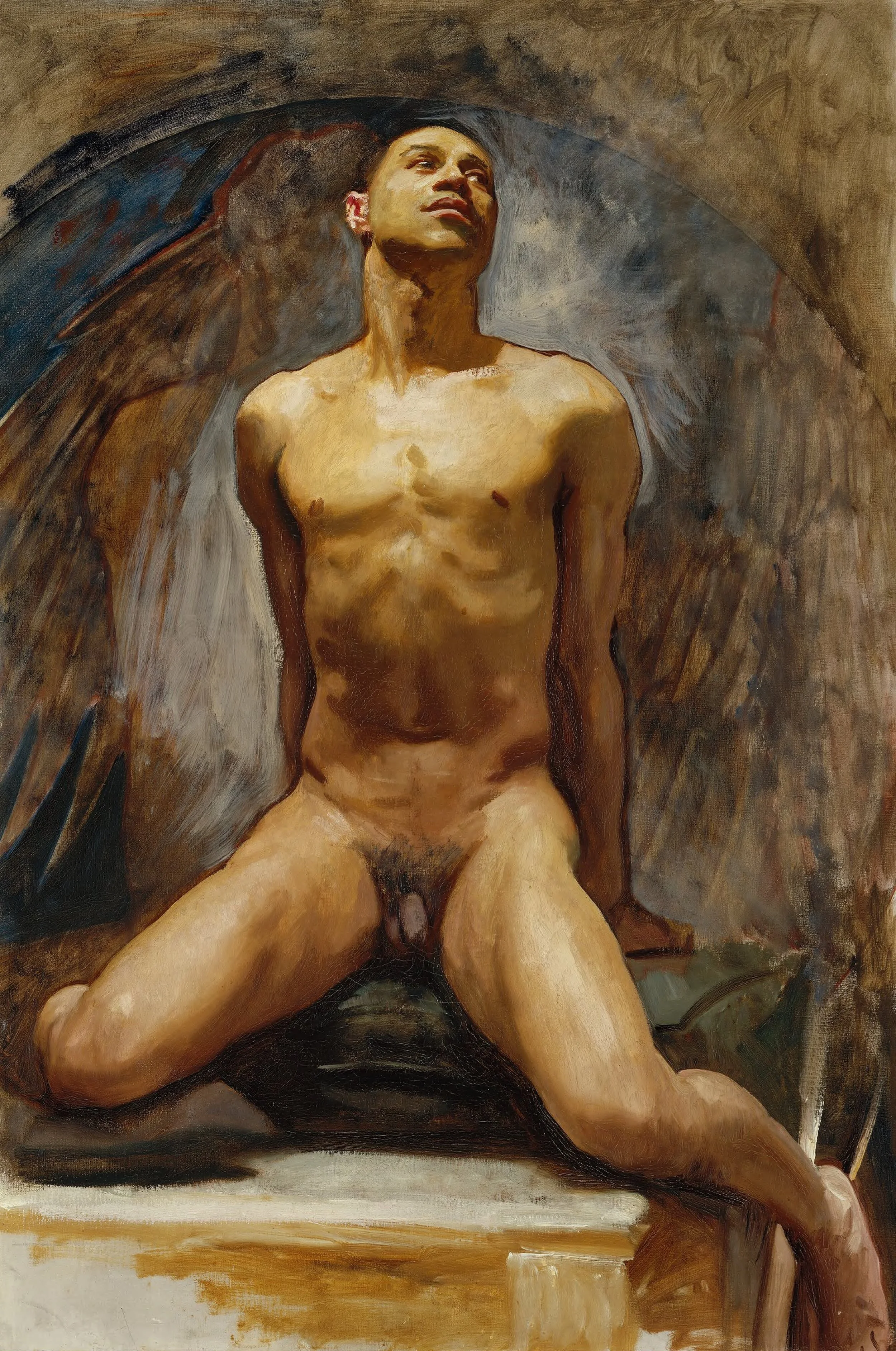
Thomas McKeller. John Singer Sargent
Go Melt Back
in the Night
During that time in his life, you could usually find Richard sitting at a table in the coffee shop reading one of his aggressively large novels and sipping Earl Grey tea. If you went during one of Maria’s shifts, at least, it was more or less a sure thing.
“Can I get an Earl?” he would ask, smiling shyly at her as he approached the counter.
“One Earl, coming up,” she would reply, busying herself with tea tins, mugs, and the choking spray of the hot water spout. And they would both smile when she said that—One Earl, coming up—because it seemed to fashion them into two men on either side of a lunch counter in a 1950s diner, or else into two young people of their own era but in a different, freer locale than this one, pretending to be those two men at the diner in the fifties: young people a lot like themselves, but with the one crucial difference: they lived in the Pacific Northwest (where the shop’s coffee was roasted), or in Brooklyn, or any other cosmopolitan city. In this alternative life, she exclusively wore things she’d found in a thrift store, but not the type of thrift store they had here in Mississippi. The kind with the word “Vintage” inscribed on the window, where you could find woolen A-line skirts in rich, harvest colors, and modest, floral blouses that would bring out the color in her eyes. He would read the same novels that he did in reality, but he would do so through glasses that were distinctly more horn-rimmed than the ones he actually wore.
By the time she was handing him the steaming mug, they were both positively glowing with the cozy pleasure of this parallel life, and with the subtle hint of melancholy that attended the fact that it was just a fantasy. In part it was his bony, coltish awkwardness that belied the portrait they had silently painted together, as well as the jeans and sweatshirts she tended to wear to work. But still, she liked his awkwardness and he liked the comforting approachability implied by the way she dressed; the warmth of their interaction would hover over the shop the whole time he was sitting there reading. Even the other customers must notice.
And it did confuse him, but with a pleasurable sort of confusion, that he could keep that feeling alive, like one of a juggler’s many balls or mallets, even while his mouth—coated in the tea’s brawny tannins and the flowery hint of citrus—watered for those parts of Jack’s body that he had only (could only have) ever felt fumblingly, under the cover of darkness.
But of course the confusion he felt while sitting there in the shop, crowded with people who knew him, could only ever be a tiny shard or sliver—barely more than a vague echo—of the deafening roar that had filled the air all around him on that first night in the tent (because, in part, of the confusion he felt about just what it was he had been touching, despite its being just exactly what he had himself)—and then had abruptly shattered into a million tiny pieces that tinkled down around him so that he would be continually fishing them out of the flesh of his feet and his fingers like this for months while he sat in the coffee shop or the library reading, or when he tried to study between classes in the dorm room where he no longer ever slept.
It was confusing.
And yet that experience had also seemed to shine backwards like a spotlight over the span of his life, causing many other occurrences to show him facets that he’d never been able to make out before in the even sunlight that had previously bathed them. The times, for example, when he had felt that overwhelming, fraternal ardor for friends on playgrounds or by the lake because (he thought at the time) he didn’t have a brother—only a sister, who was six years older than he was, who was therefore off in her own, unfamiliar world. Or the times he’d been unable to sleep, his heart pounding against a friend’s mattress until he got up and wandered out into the strange, darkened kitchens and living rooms where he felt so out of place. Maybe it wasn’t just the unease of being in an unfamiliar house that had driven him out of those beds.
All of these things seemed totally different to him now. His life was reorganized, and something about that reorganization made it permissible for him to hang all over Jack in public, ostentatiously pressing their bodies together, sitting in his lap, twirling his fingers in his shaggy hair, whispering inside-jokes into his ear. And no one around them seemed to question this behavior, either—perhaps in part because it seemed too blatant and over-the-top to actually mean what it seemed to mean. But also because of the position Richard occupied vis-a-vis the town. In some ways he seemed to hover over it, so that none of its rules and conventions could ever quite reach him. Some people who were familiar with his background explained this to themselves with reference to the fact that his parents were professors at the university. They were transplants—itinerants, even—so you could hardly expect them to fashion their lives in accordance with the preferences of their neighbors. They were exempt, but they also lost something as a result of this exemption. Something big.
Anyway, Jack was an itinerant too, in a lot of ways. He was only there for college. At least that had been the case before he stopped enrolling in classes. Now he was simply stranded, the only other workable option being to move back to Corinth where his alcoholic father might expect some modicum of attention from him. It was this feeling of rootlessness that made him so sensitive to the lyrics about vagabonds and highwaymen in the Bob Dylan and Johnny Cash songs he was always teaching himself to play on the acoustic guitar. Still, now that he could no longer live on his student loans, he didn’t have any money other than what he earned waiting tables, and consequently he was less insulated against the town’s directives than his friend was. The way the two of them acted in public had become something of a problem for him. It inspired him with a vague sense of foreboding: what if his manager saw them, or Mary Grace? That foreboding had somehow been absent from the initial, clumsy pleasure of those nights in tents, dorm rooms, and pallets on the floor.
And yet he didn’t have the heart to put a stop to it. Not only because he was worried about hurting his friend, but also because the evident power of Richard’s feelings shocked and gratified him. He had never seen anything like it, and certainly not directed at himself. But though this was obviously flattering, that wasn’t the only reason it fascinated him. It was like his friend’s ardor was contagious; though Jack himself had little interest in male bodies other than his own, the hungry way Richard touched him on sweaty nights under the sheets—the way his hands roved over his body as if they were close—so close—to what they had for so long denied themselves (dipping beneath the tensile barrier of skin, burying themselves in the close wet tightness between his organs)—that was just objectively hot, and Jack had no compunctions about admitting it. At least not to himself, in private.
But just like with so many of his pleasures, this one had gradually revealed itself to be a trap. He thought especially about one of the trips they had taken recently, to Memphis. They took these trips two or three times a month, for no special reason. The ritual generally included seeing a movie at the indie theater, which had films that they would never have been able to see in Oxford, then eating dinner somewhere nearby before driving the hour and a half back home. Though Memphis was no great metropolis, it gave them a gratifying sense of freedom to escape for a few hours into a more urban environment. On the night in question, the restaurant they chose was a Vietnamese place that Maria had recommended, within walking distance from the theater.
The whole night had been carefree and redolent of blooming flowers; it was spring, and flowers were crowding the lamplit streets, hovering above them, creme-colored and carmine in the branches of trees and burbling up in purple waves out of planters so that, as they walked side-by-side, they felt like holding hands, or going arm in arm. Everything was easy between the two of them just then—there had been no signs of trouble at all, at least not until they made it to the restaurant and their appetizers arrived at the table.
They had ordered Vietnamese summer rolls, which turned out to be encased in a funny wrapping that neither of them had seen before. It was soft and translucent, so that you could clearly see the vegetables and meat packed firmly inside the thick rolls, and it was warm and rubbery to the touch. Jack was hesitating, touching his roll trepidatiously and wondering if the outer skin was even edible, or if you were meant to peel it away and eat the contents by themselves. But this idea didn’t seem to have occurred to Richard, who simply popped one end of the strange, rubbery roll into his mouth. Looking up, Jack saw a look of sheepish recognition come across his friend’s face, and when their eyes met, the thick roll still protruding from between Richard’s lips, both of them burst out laughing.
Their laughter was inappropriately loud and long-lasting; it kept rolling out of them even as both of their faces reddened at their embarrassing inability to stop it: here they were—all their secret, pent up feelings, which they had never yet been able to discuss or so much as acknowledge in the daylight, even between themselves, bursting up like a geyser in the middle of a crowded restaurant. Which would have been fine, even pleasurably amusing, if once the laughter finally abated, Richard hadn’t looked down at the table as if he were simmering with shame or desperation—as if he might cry. Which made Jack acutely aware of the feeling that this was something he had done to Richard.
It seemed like he was always doing these things to people he cared about without ever intending to do them. To Richard, to Mary Grace. That was another reason he loved those old songs by Dylan and Johnny Cash. He played them over and over to himself when he was alone at night in the house he rented outside of town. These songs about itinerants and wanderers and flash-in-the-pan romances seemed to imply that these musicians from his parent’s generation were possessed of an ineffable sort of freedom or authenticity that people today could no longer achieve. And it was his grief at being trapped here in the wrong time that sometimes made tears come to his eyes when he was singing alone at night. But it was that same thing that made everyone clap so enthusiastically after his performances at open mic night, even though his skills at the guitar were negligible, and his singing voice was even worse.
And wasn’t it also this very articulation of his personality that bound Mary Grace to him so inescapably? So that she was completely unable, despite what she might have wished, to put an end to their entire, degrading relationship? Even though she felt sure it was his fault that the sisters in her sorority had recently given her the cold shoulder.
He had never fit in with them very well, after all. At house dinners, his contributions to discussion led more often than not to uncomfortable conversational cul-de-sacs, and even awkward silences. Not that there was necessarily anything wrong with what he said—but that was just the problem. It really didn’t matter what he said, as long as he said it while wearing those ridiculous cowboy boots and western-style button-up shirts with mother of pearl snap buttons; as long as his hair was shaggy like that (like a crazy person's), hanging down around the Ray-Bans he insisted on wearing even inside and on cloudy days. Other sisters’ boyfriends wore Ray-Bans too, of course, and even cowboy boots, but Jack wore them differently. On him, they seemed to allude to an entire world, or worldview, that was just simply out of place at a house dinner—offensive even. They made him snobby or pretentious, like the townies who rolled their eyes at you just for being in a sorority.
And then, of course, when she moved out of the sorority house and into his house—even though she had only stayed there for a couple of months in the end—that was just a step too far for the sisters. She could hear their scandalized, disapproving tones when they discussed it behind her back. Bitches.
Still, she should never have done it. But how could she have helped herself? They had been sitting on the back porch of his house when he’d asked her. They’d been sipping beer out of bottles and whiling away the sunset hours, letting the night swell up all around them with its cicada sounds and wet heat. He’d just been playing Jeff Buckley’s “Hallelujah” for her on the guitar, a certain verse of which always made her body light up in a swoon, burning with the desire one day to sit him down on a stool in the kitchen and cut his hair.
All of it—the beer bottles piling up, the twanging, poorly-tuned guitar, the cicadas—it suddenly seemed so much more real to her than the things she liked about her sorority sisters. Pretty girls standing at the tops of staircases, wearing dresses that used tulle and taffeta in exciting new ways, and the boys below, who—for all their boyish dalliances and hijinks—loved the girls; adored them; paid homage to their delicate limbs and their porcelain skin. It was an image that reached back over the span of her life, back to when she was a little girl and adulthood was Disney and Scarlett O’Hara, and didn’t necessarily have to take place in the modern world.
But despite her delicate limbs and her porcelain skin, none of that had ever been quite within Mary Grace’s reach, though it did seem to be in the reach of other sisters in her sorority; no, it was always a stretch for her, for whatever reason. And this porch in the night with Jack was tantalizingly right here, completely within her grasp. Maybe it was because of the way both of their fathers were, she wasn’t sure. Anyway, here at his house, she was allowed to indulge in other desires as well—ones that she could never have admitted among the sisters. She could cling to him and demand things that made him blush in the darkness. She could call out, and scream if she needed to. So how could she say no when he asked? At least this was hers. And anyway, maybe she could have both things, since she wanted them both—and why shouldn’t she?
But of course it hadn’t worked out that way. He never did let her cut his hair; he did that himself, in the bathroom, with a picture of Ryan Adams taped to the wall next to the mirror. And gradually, rolling her eyes stopped seeming sufficient for expressing her disgust with him. And that disgust, it seemed to her, was the reason that she kept finding herself in these degrading situations, like the night when he stopped the car on Jackson Avenue and jumped out into the street to escape their fight. And then he’d begun undressing for some reason, right there on the pavement, as if this were somehow the inevitable result of their argument, though in reality it was just something he did sometimes when he was blind drunk. And though she refused to give him the satisfaction of getting out of the car and trying to stop him, and though the sight of his nakedness in this unusual setting, under the brutal illumination of the streetlights, actually sent a thrill through her own body, making her feel like writhing against the carseat, she had contented herself with screaming at him out of the open driver’s side door, “What the fuck is wrong with you? You disgust me! Put your fucking pants back on, loser!”
She wasn’t sure how they avoided getting arrested that night, even if it had all taken place at three in the morning on a deserted street. But at least it provided her with a dramatic enough event to use as a fulcrum. The next day she packed her things up and moved out, even though it meant calling her father and asking if she could stay in the condo he kept in town for football weekends. She knew she needed some distance to get her head on straight.
But instead of providing a healing respite, the time she spent squatting in her father’s condo was when the true extent of her abjection became clear to her. She was unable to sleep or to eat, and then she ate so much that she vomited. She spent hours staring blankly out the window or at a wall, lying prone on the flood of her own internal discontent. Then suddenly she was inspired with manic activity. She slathered on make-up and went from bar to bar; she fucked people she couldn’t stand, whose names she did her best not to learn. And most degrading of all, again and again she found herself driving back and forth past Jack’s house, out on its country road that was on her way to nowhere. Intuiting dark meanings behind the cars she saw parked in the driveway. Richard’s car most often, but also sometimes Maria’s. Were they a thing now? Mary Grace glared at her in the coffee shop when she ordered her mocha, but Maria’s friendly attentiveness was impenetrable.
All of this roiling tension finally exploded one day when she was walking by one of Jack’s favorite restaurants on the square, her eyes (all blood-shot from crying) concealed behind Ray-Ban sunglasses. Through the large picture window on which the restaurant’s name was inscribed, she couldn’t help but notice Jack sitting at a table with Richard, the two of them laughing together as if everything were perfectly right with the world. And indeed it was a sunny day, and everyone on the square seemed to be enjoying it, drinking up the scent of flowers hanging heavy on the air. In part, it was the beauty of the day that drove her to do it, as well as that of the two boys’ faces—their evident contentedness at being there together, laughing in a restaurant where she could no longer even eat for fear of running into Jack. Suddenly she was inside, standing next to their table. She was crying; she was screaming. What was she even saying? It was incoherent, even to herself. And to the large number of people witnessing this right now, how ridiculous she must seem.
And to be honest, it was difficult for Angela, who happened to be standing there on the sidewalk outside the window just then, to stifle a laugh. It wasn’t that she felt like laughing at Mary Grace exactly—clearly this girl was going through something, and Angela felt for her. It was more like a laugh of amazement, or a laugh at the absurdity of the situation—at the faces all three of them were making. There was Mary Grace, of course, who looked like she had been possessed by a demon of righteous indignation, but the really funny expressions were those of the two boys. Jack was sitting there looking not so much stunned or indignant as resigned to his fate. His whole form had a kind of pathetic slump to it, like a dog that knows very well it shouldn’t have ripped open the bag of kibble. And Richard! Richard was the one who really sent Angela fleeing from the window before she lost all control: he had this look on his face like he’d suddenly awoken from a coma to find himself there in the restaurant; he was casting his eyes to the left and right, as if begging the people sitting at the tables around them to explain where he was, or what was happening to him, or how he might escape from it.
But luckily she did suppress her laughter, and none of the three people at the center of the drama inside the restaurant noticed her watching them from outside. It was one of her super-powers, going unnoticed. Or rather, invisibility—that was what it would have been called if it was a real super-power. In fact, she had been making use of her invisibility just then, when she caught sight of Mary Grace going into the restaurant and couldn’t help but peek in through the window to see what happened; she had been following Richard for over an hour, and was walking by the restaurant again just then, to see if they were still there. It was a thing she did sometimes, following Richard.
She had been doing it ever since high school—ever since she realized that, even though the two of them were pretty good friends and had known one another since they were in diapers, if she happened to see him around town, his eyes tended to slide right over her as if her image were coated in oil or lard, and keep right on going without ever registering her presence at all. She was pretty sure she knew why this happened, and though it was definitely hurtful, she didn’t hold it against him. It was clear that he really didn’t see her; it wasn’t that he was trying to get out of talking to her or anything. And anyway, she didn’t exactly have room to be picky about who she was friends with; on those occasions when he was actually able to pierce her cloak of invisibility, he seemed to be genuinely fond of her. He was the only other person her age she’d ever met who had read Octavia Butler’s novels (which weren’t the sort of books they were assigned to read at Oxford High), and also the only one who seemed to have any inkling of the masochistic pleasure she drew from coming to school decked out in her metallic spaceman costume and wraparound shades, pretending to be a cyborg. She suspected that the other boys probably just thought she was autistic. Unlike them, he laughed at her jokes; unlike them, he seemed to find it endearing that she’d never stopped wearing her hair in tiny braids with plastic clips on the ends, like a little girl.
In fact, that’s what he had done on the day back in high school when they had kissed—he touched her braids. And though touching them had seemed at the time to be a way of changing the subject, there was also a real fondness in the way he did it, rolling one of them back and forth between his fingers with a far-off look in his eyes as if he were remembering something, or working out a difficult math problem in his head. If she hadn’t been hoping to see a slightly more pointed expression on his face after something like that—it was her first kiss, after all—she might have found it touching.
That had been hard for her, even though she shouldn’t have let it be. How to process a rejection that didn’t even bother to be a rejection? But then she supposed it was easy for him to reject people; easy for him to be picky that way. After all, you could barely tell, even looking at Richard’s father, that there was any black blood in their family at all. As for Richard himself, people just assumed he was Italian, or maybe Jewish. He didn’t know what it was like for her here. And there was no use pretending that things like that didn’t matter. But of course a lot of it was her fault, too: she never should have kissed a boy whose eyes slid over her that way.
Overall it hadn’t turned into any great crisis. They continued to be friends, even though she was forced to change certain things about the way she treated him. No more using her “Richard” avatar on the science fiction MMORPG she played online, which was too bad because he was the highest-leveled character she had. No more acting chummy with his dad when she ran into him on the way to her own mother’s office on campus in the hopes that he might mention to Richard that he had seen her. No more wolf whistling or yelling “Damn, boy!” when she saw him running in his tiny, cross-country racing shorts, so that he would blush, then laugh, then slap himself on the butt and stick out his tongue as he ran past her. Maybe she had been too straightforward for him to really take her interest seriously.
But though she had taken all of these steps to rein herself in once she finally got the message, she never did stop following him around town. Partially because she simply enjoyed it too much to give it up, but also because, when she followed him, it seemed like a pretty impersonal thing. Her emotions weren’t really invested in it; it was just something she did. She would watch him reading his giant paperbacks at the coffee shop from a bench across the street. When he was finished reading, she would follow him to the book store, where she would browse whatever section provided the most cover in case her invisibility cloak suddenly wore off. More often than not, this was all that he really did, and if she had been following him in the hopes of learning something new about him, she would have given up a long time ago.
But then, every once in a while, she did witness something that gave her a new understanding of what might be going on behind those glasses, or under the silly argyle sweaters and expensive jeans he wore every day.
Like for example, the time when she had been watching Richard and Jack through the window of the coffee shop at night. Because of the bright lights inside, though she could see the two of them perfectly, as if they were lit up on a stage, they couldn’t see her out there buried in the darkness at all. So she was able to take her time noticing things that she otherwise wouldn’t have had the leisure to. At first it seemed like a chance to drink up the funny adoration that was so evident between the two boys; the funny way boys will act so diffident with one another and then, as if something has ignited all of a sudden and burned away their inhibitions, suddenly let themselves be carried away in a flood of affection far more shameless and penetrating than anything girls, who have more practice and tend to dole out their intimacy more evenly, would ever be caught dead displaying openly like that in public. That was what she wanted to notice about them that night when she saw them in the coffee shop—in a strange way, she craved it—but as it turned out, something was wrong with Richard that evening. He had the look of a crumpled up tissue, or a towel just in the process of being wrung dry. For his part, Jack was doing his best to be oblivious to whatever the problem was; he was being finicky with the eye contact he made with his friend, and he kept glancing at the clock that hung on the wall above the counter.
Finally, after enough time seemed to have elapsed, Jack said something to Richard and the two of them started packing their things up to leave. This was Angela’s cue to hurry away from the window and start up her car. She watched them cross the street and get into Jack’s small, black Toyota. She followed the car at a safe distance, knowing already that they were heading towards Richard’s parents’ house. What she didn’t know was whether Jack would go inside with Richard, or just drop him off. She hadn’t determined yet whether he actually slept over on the nights when she saw them go inside together, or if the two of them just stayed up for a few more hours talking or playing video games, or whatever it was that boys did by themselves in dark houses at night. So far she had never been dedicated enough to her investigations to drive by again in the middle of the night to see if his car was still there.
And though Jack didn’t follow Richard inside that night, what she saw before Richard got out of his car completely changed her view of the situation, and more or less answered the question of what went on on the nights in question. She’d parked a ways down the street so as not to arouse suspicion, but because of the other car’s placement in relation to a streetlamp, she had a pretty clear view of at least the silhouette of the two heads in the front seat. Richard’s head in the passenger’s seat was bowed, and Jack was looking out the driver’s side window. They stayed that way for quite some time before Richard turned to look at Jack. He must have said something, because Jack turned too, and the two boys sat facing each other for another several moments. Though she couldn’t hear what was happening inside the car, Angela felt like they weren’t saying anything at all; she had the feeling that they were stewing in a tense silence, just staring at one another in the car under the streetlamp. Then the one head approached the other quickly. Richard had jolted forward suddenly, as if he were trying to surprise Jack—and the surprise was a kiss. Which made Angela gasp into the silence of her own car, across the gulf of empty night.
At first she wondered if what she was seeing was the two boys’ first kiss, because Jack’s initial reaction was to push Richard away in what looked like shock, but also could have been disgust. Angela’s heart jolted with sympathy for Richard, but then, almost immediately, Jack seemed to regret the forcefulness of his reaction, and pulled him back. Though they didn’t kiss again, the way Jack cradled Richard’s head on his shoulder made it clear to her that what she was seeing wasn’t quite a rejection. Still, she wondered if Richard was crying. Soon, he got out of the car and, head hanging low, went inside alone.
The first thing Angela felt after Jack drove away was, strangely enough, relief. It was like she’d been set free. Like her rejection at the hands of Richard was no longer her responsibility, but just the inevitable expression of a natural law that she had nothing to do with. She felt a strange elation. But then the edges of that elation started to darken and curl as if they were being singed by fire or some kind of desiccating disease. Sometimes, despite the impersonal attitude she tried to bring to her investigations, her practice of following Richard did backfire that way. She would be consumed with a very specific kind of despair, or even disgust at herself. It didn’t have anything to do with whether or not Richard wanted her anymore, or why he had rejected her; there was more to it than that. It was about her own feelings, her own desires. What was she for? She would go home, put the fishbowl helmet from her spacesuit on over her little-girl braids, and sit in the bathtub for a long time.
But then after a week, or sometimes a month of quiet dejection, she would catch sight of Richard at the coffee shop or the book store again and immediately be back to tailing him like Jimmy Stewart in Vertigo. She especially liked to follow him at night, though he rarely did anything very interesting after dark. Sometimes he would meet up with friends; sometimes he would sit at a bar, but generally he would just wander around, with Jack or alone, and she would wander after him. Then they would each go home.
But more than what actually happened during these nighttime outings, what she liked was that her power of invisibility teetered tantalizingly on the border between the figurative and the literal. Sometimes when she was leaving the house in order to haunt Richard’s usual hangouts, her mother would catch sight of her going out the door dressed all in black and call out, “Hope you’re not planning to cross any streets tonight!” But no car could hit her when she was out like that. She was too observant for that—she was all observation; she pictured herself as just a couple of glaring white eyeballs floating in the darkness. Sometimes when she was following Richard along one of the town’s humid streets, she liked to imagine that she was dissolved in the night in an even solution, and consequently knew what the night knew—what it was like to press up against his skin. What it was like to hug him tightly while he pressed up against someone else. And gradually (had this always been the case?) she had come to realize that that was what she wanted. Not to be in bed with Richard herself, but to cling to him like a film while he burned with desire for someone else. To sink down into him and caress those feelings of his at their roots, and then to sneak away undetected.
And that wasn’t something that anything in her education had taught her how to feel appropriately. It made her feel cut off; outside; as if she were regarding all these people—herself, too—from some faraway place, with little more than vague curiosity. Wondering what they were all doing, milling around that way? What were they waiting for? For something new in the world, she thought, from her faraway vantage—for something born on their hands and their lips that, all unexpected, could alter their seemings, tame them. So that one day, when time was ripe, they could be found—gathered up for the slaughter.
Back again to the bathtub, where the glass of her fishbowl helmet would fog up, completely opaque with the steam rising up off the water, and the steam of her breath.
Then back to Richard’s favorite spots. Sometimes, when he wasn’t with Jack—when Jack was with Mary Grace, and Richard had nothing to do—she would catch him looking so forlorn, in a way that seemed to mirror her own feelings. He would just wander the streets, taking sudden turns and speeding up and slowing down as if he were following someone himself. He would be thinking about Jack, or rather, about his own feelings—about what his feelings for Jack might mean. What would have to change? Would he dress differently? Would he read the same novels, or would there now be other ones that would be more appropriate? He imagined a “coming out”—friends and family gathered around to recognize something about him. An expedience that would warp him. Dredged up into daylight. Somehow, though he knew it was the wrong feeling, the thought of it demeaned him. Angela saw it clearly, a life looming up before him, terrifying and solid, and himself lodged in the gap between that one and the ones he had now.
But he couldn’t see that himself; all he knew of it was this feeling of dejection, alone in the wet streets, reeking of flowers. When he felt this way, he often found himself in the coffee shop, hesitating between the door and the counter. He didn’t want to buy anything, and since she worked in the mornings, it wasn’t Maria standing there beckoning him with her smile. She was what he wanted, why he found himself here again and again, night after night. He wanted her calm composure, her sweatshirts and jeans. He wanted the lives that rose up off her skin so easily, like a fragrance exhumed from her flesh. She knew something he didn’t and, had she been there, she might be willing to show him. But of course, she wasn’t there. Where was she, he wondered.
This was another mystery he could have solved if he had only thought to ask Angela; she had been there, in the living room of Maria’s small apartment, and she knew that Maria spent most of her nights there by herself. She didn’t care to go out drinking, and since that was more or less what was on offer in a town like this, she tended to let her evenings pass sitting at the small desk next to the window under lamplight. She only had three more semesters left before she could leave this place.
She was taking classes toward a degree in nursing, so she had plenty of things to do at her desk. Building her arsenal of clinical vocabulary. Colorful schematic illustrations of flayed and prosected bodies. But though she never ran out of work to do, some nights she would take a few hours for herself. She liked to write short stories, when she had the time. She didn’t necessarily think that she was any good at it, but it did give her the occasion to use words like tulle and carmine, and that often seemed like enough for her. Enough, at least, to fill the time that remained.