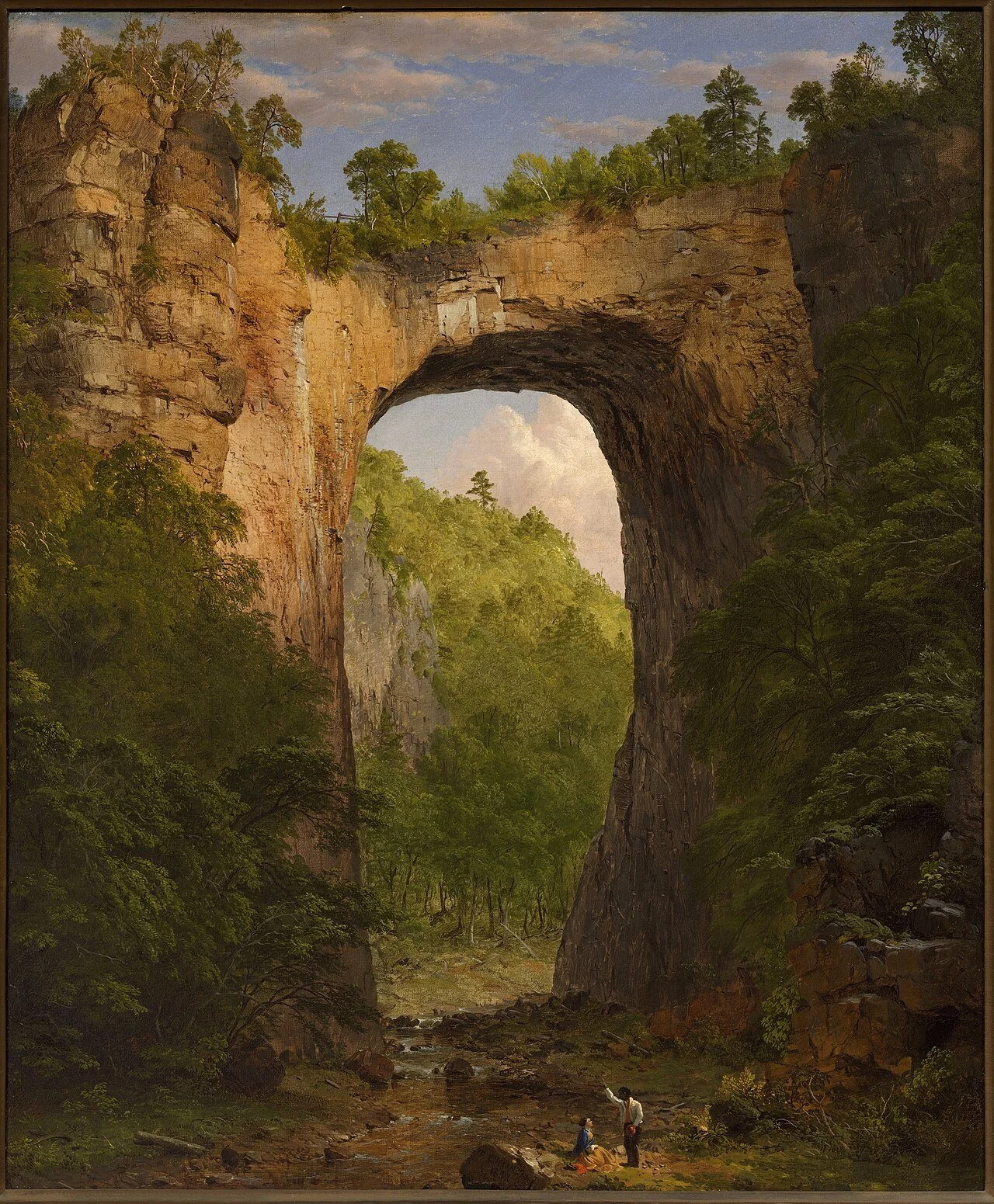
The Natural Bridge, Virginia. Frederic Edwin Church
Natural Bridge
to E.
With evening falling on the first day of my drive, I started to look for places to stop for the night. I know you made the whole drive in a single, manic piece once, but I don’t smoke cigarettes and have a much drowsier disposition. On top of that, the past two weeks in New York had left me bone-tired and anxious. I’d left early, and planned to spend at least two or three days on the road, so I didn’t feel any particular need to drive on into the night. The next major town was Roanoke, so I decided to stop there. But before long, I started to see huge signs along the road advertising a “Natural Bridge.”
Since there was plenty of daylight left, I pulled off and followed the signs down a winding back road that eventually opened up into a small valley between steep, forested hills. Partway up one of these hills was a huge, colonial-style building labeled, “Natural Bridge Hotel.” The other buildings in the valley, I noticed, all seemed to have similar labels: “Natural Bridge Gift Shop,” “Natural Bridge Baptist Church.” The whole place looked sort of fancy and derelict, like it had once been a booming resort but had recently fallen on hard times; there was only one other car in the huge parking-lot that filled the bottom of the valley.
As I pulled up to the hotel, I had a sudden, strange feeling of deja-vu, like I’d dreamed about this place very recently, though I couldn’t remember the dream, or decide if it had been a pleasant one or a nightmare. It was an unsettling feeling, but one that seemed to draw me to the place rather than repel me. I got out of the car and went inside. I crossed the lobby, passing a huge doorway labeled, “Colonial Dining Room,” that was flanked by two marble busts of George Washington and Thomas Jefferson, each in front of his own huge, gilded mirror. At the desk I asked what their cheapest rate was, and the attendant told me that, since it was the off season, she could give me a room for only $85. This was more than I had budgeted to pay for a single night in a hotel, but I took it anyway, deciding I would make the rest of the trip to Mississippi in one day. Maybe it was just the fact of being in between places, but I suddenly felt like staying here would somehow be important to me. I guess I was hungry for an experience to mark the transition—a sign, or at least some vague hint that moving back to Mississippi wasn’t as terrible of a choice as it seemed to be.
My room was relatively large, with two double beds and windows on both the front and the back walls. On one side, the view looked out over the parking lot and the valley beyond, the gift shop and the “Natural Bridge Wax Museum.” On the other side, it looked straight into the woods. The room was nicer than I had expected, but I couldn’t shake the unease that had brought me here. This wing of the hotel seemed to be totally deserted except for an older man in the room next to mine who sat out on the patio spitting juice from chewing tobacco into an empty soda bottle and refusing to acknowledge me when I said hello. I started to worry that I’d paid way more money than I should have for an experience that might turn out to be unpleasant, or even somehow terrible. I couldn’t shake my initial superstitious feeling about the place, and it started to feel more like a sinister foreboding than simple deja-vu.
I went for a walk, or tried to. I asked in the gift shop if there was a trail that I could take, since most of the roads wound up into the hills and seemed treacherous to walk on, but the anxious, sickly-looking girl working the desk (the only person I’d seen under the age of sixty-five) said that the only trail was the one to the natural bridge, and it cost money. I wanted to save the actual bridge for the next day, so I just wandered up past the “Natural Bridge Baptist Church,” with its swing-set directly overlooking a small cemetery. I wandered through a community of tiny, deserted houses that I eventually reasoned must be rented by the hotel during the busy seasons, wondering idly how much it would cost to stay in one of these. I did find a trail, but it was overgrown and blocked off by a portal that was carved to look like the head of a giant gargoyle whose mouth was filled with a locked gate. Several signs around the gate said, “Posted: No Trespassing.” Since it was getting dark, I didn’t.
By the time I got back to the hotel, it was totally dark. I loitered in the parking lot, eating what was left of a sandwich I’d brought with me, and looking at the stars and the shadows of the mountains jaggedly blocking them out. Suddenly, a masculine voice began to boom out over the landscape, literally echoing off of the trees and surrounding mountains, intoning in a measured, stately cadence, “…And the earth was without form and void! And the darkness was upon the face of the deep!...” The voice paused for effect between each day of creation and dramatic classical music swelled up in its place. I’m not sure exactly what the piece was, but it reminded me of the piece that played over and over in that Lars von Trier movie we saw together that time at IFC. It had that same over-reaching ache and expectancy to it that I love, and it reminded me of you. I immediately planned to write you an email about this experience, though I wasn’t sure how you would feel about hearing from me after everything.
Disoriented, and a little terrified, feeling as if I were in a film or a dream, I began to search for the source of the sounds. “…Let there be lights in the firmament of the heavens to divide day from night! And let them be for signs, and for seasons, and for days, and years!...” I walked a ways up one of the roads, thinking I saw some lights flashing against the trees, but it became pitch dark as the road wound its way into the woods and the music was so loud that it seemed like it was coming from everywhere instead of a single place. Afraid of being hit by cars coming around the curves in the dark, I turned around and went back to the hotel.
I went through the dining room and into the “Red Fox Tavern,” where I ordered a gin and tonic and asked the bartender about the voice. She laughed and said, “Oh, that’s just God,” and explained that they do a light show on the natural bridge every night called “The Drama of Creation.” You can hear it all over town. The bartender turned out to be a really delightful person, who told me about her online bookstore where she sells children’s books from the 1940s and ‘50s that she scavenges from Goodwills and yard sales in the surrounding communities. She told me that the trunk of her car was full to the brim with children’s books. Her friend, who also worked at the hotel but was off duty and sitting at the bar, told me that actually she had a trunk full of children and that she stuffed her oven full of children as well. The bartender laughed and said, “Have you seen my tiny kitchenette? Not a lot of kids would fit in that oven, unfortunately.” I liked them, but I wondered what they were doing living in Natural Bridge, Virginia, which I learned from Wikipedia using the bar’s wifi, isn’t even incorporated, and seemed to be populated (based on my own experience so far) exclusively by geriatric people. Satisfied that I wasn’t going insane, and that the world wasn’t coming to an end, I went to bed so that I could get an early start the next day.
In the morning the entire valley was so full of fog that I couldn’t see past the parking lot. There were more cars than there had been the night before, and more of the rooms’ windows had curtains drawn. I ate a surprisingly cheap breakfast among several elderly couples in the dining room, and made my way to the gift shop to buy a ticket for the bridge as the fog burned off in the sun. I was horrified that it cost $20 to see something that should by all rights be free, according not only to me, but also to the anonymous author of the poem framed in the hotel lobby, entitled “Natural Bridge”:
“…But even in winter this is not a place to be alone; others
have as much right as I to stand here looking up,
to have the blood surge and dizzy the head, to let
the chisel of Cedar Creek cut into them…”
Despite the flagrant hypocrisy, I gave the woman her money and set off along the trail that extended out of the back of the gift shop.
The trail was paved, with a low brick wall running along the left-hand side. It followed a small stream, which was actually very beautiful as it burbled over the rocks, though I found myself unable to enjoy it. The fact that I’d paid $20 and entered through a gift shop made it all seem fake, like the rocks were made of cement and the water at the end was pumped back to the top and recirculated. A chipmunk scurried across the rocks, which added to the feeling that this place was too cloying to be quite realistic. By the time I came to a little cabin with a café in it, where an elderly man in a vest that said “Natural Bridge,” hobbled out to check my ticket again, I was pretty disheartened and almost didn’t even want to continue. But he waved me along as if there were no longer any question of turning back, so I went.
I was ready to be disappointed and to get back into my car that afternoon angry at myself for having wasted time and money, annoyed that I’d now have to take the rest of the drive more quickly than I’d planned. But when I turned the corner and saw the giant arch there dizzyingly huge and hollow, my breath caught and there were actual tears tickling the corners of my eyes. I’m not sure I can explain why it affected me so strongly—I’ve seen the Alps and the redwoods and all different types of natural attractions, but this archway really amazed and frightened me. You should look up pictures, but they don’t do much to show you the actual thing. When you’re there, it seems like it can’t possibly be real, as if it were the set of some science fiction movie by a director drunk with the power of CGI. It’s so big that there’s a highway and a forest on top of it.
Drops of water were dripping from the underside of the arch, catching the sun and falling from such a height that they looked like flakes of silver or mica floating gently to the rocks beneath. The path continued right through the arch, with the stream still running along the left-hand side. As I walked closer and passed underneath it, I could see that the sides were striated with colors so that you could see where the water had worn the rock away, dripping and flowing continuously for centuries. I’m sure that while you were in Germany or Chicago you probably saw the abstracts that Gerhard Richter makes with a giant squeegee. He just covers the squeegee with paint and drags it along, layer after layer so that there are uneven depths of paint on the canvas. Here and there the squeegee rips up color from the lower layers, and the idea is that you can see the process of the painting’s creation, like you’re looking at a recording instead of just a still image. The sides of the natural bridge are like that, but this process took as long as the world took instead of a few hours or days. Standing there, you think of all the things that have been born and died while that rock was being made. You picture a time-lapse video, the rock melting away like butter in the sun while the nearby animals and vegetation fly by so fast that they look like a blur or a fog, or are simply invisible.
The natural bridge was one of the first tourist attractions in the US, as I’d found out from a plaque earlier that morning, and it makes sense that for hundreds of years there would be a more or less steady stream of people passing under it—a new brushstroke on the time-lapse video, pulsing and fluctuating with seasons and changes in the tourism economy. Thinking of it that way made the movement of all those people seem almost like a tide, or a like the migration of fish or butterflies (except each of these fish had to pay $20 to be included in the group). I thought of the feeling of a cathedral, when you know that thousands of people have entered this space and looked around and whispered, and then stood uncomfortably, and then left. Even if it’s perfunctory and little kids are whining that they’re hungry and bored, still it becomes significant.
I found out from the same plaque that George Washington supposedly discovered the bridge while surveying the area, and that locals have a legend that he was strong enough to throw a stone over the bridge and down into the creek bed on the other side. According to Wikipedia, people say the same thing about Thomas Jefferson. Reading that and then looking up at this bridge and feeling the nervous blood pulsing in my neck, it occurred to me that the only kind of history that could make George Washington or any other person seem significant in the face of this thing was a mythic one.
Even though there was no one else on the trail, I immediately felt embarrassed by my gaping and the dampness in my eyes, and I kept walking out of a sense of propriety. Thoughts were buzzing through my head and I felt like I had to write about this immediately. I had my journal with me and I could have crouched down and started to scribble away, but now I was impatient to see what else was on the path. Soon I came to a recreation of a Monacan Indian settlement. It was surrounded by a circular fence called a palisade made of vertical posts with horizontal sticks about the height of a person. Inside were a few round huts made of bark and straw, a couple of racks where animal hides were drying in the sun, and two people—an older woman and a young man—who were very smokily trying to light a fire. I tried to ignore the fact that the woman was wearing hokey Native American clothing despite her pale skin and the single, grey braid of hair hanging down her back. (The young man at least had the sensitivity to be dressed in a Northface jacket and jeans. He looked puffy-eyed and put-upon.) I stood and watched them for a minute, thinking about the palisade and what it must have felt like to live inside it, and of the animals it was meant to keep out. I looked at the small patch of corn and other vegetables growing in lines, held up by wooden splints just outside of the perimeter. The circle of the village and the rectangle of the garden, how people divvy up space and force it to do what they want it to do, but also how satisfying it must have been for these people to be able to walk out and stand on the earth of the garden and think that these plants, unlike all the other ones around them in the forest, were growing because they told them to—because they had chosen them. So they could stop wandering and settle down; so they could wrest control over a small amount of space for a short amount of time in order to be comfortable, together.
While I was busy thinking these things and wondering if you would be able to point me to a passage about it in The Sacred and the Profane, an older middle-aged woman came and stood beside me. After we’d been standing there a moment looking together in silence, she pointed to my journal, which was under my arm. “You have a notebook. Are you looking for something specific?”
I said I wasn’t, that I just carry it around with me most of the time when I’m doing something out of the ordinary. We were silent for another moment while the young man half-heartedly fanned the flames with a thin piece of wood, and then I asked her if she was staying in the hotel. She said she wasn’t. Unable to think of anything else to say, we set off together along the trail. She walked strangely. It was a combination of a lope and a shuffle, which sounds impossible and looked as uncomfortable as it sounds. She was very top-heavy, with a large torso and small, skinny legs. Her face looked frozen, like she was in the process of recovering from paralysis.
In the course of a halting conversation I found out that she was a nurse from Michigan. She told me that she liked to use her vacation days to travel—that you don’t have very many vacation days when you’re young but as the years go by you get more and more. I noticed she was fond of using the general “you,” regardless of whether or not what she was saying even plausibly applied to me. She told me about a bus trip she had taken to Stonehenge and all over England and Wales. She seemed very excited to tell me about it. She told me that they allot you a certain amount of time for each sight on a bus tour, but that they also include time for lunch in different, convenient spots along the way. Proudly, she said that even though most people on the tours stay in one place to eat their lunches, she always grabs a sandwich and sets off to see as many things as she can. “If you just sit in a restaurant, you don’t see anything!”
We came to a fork in the path, one side of which crossed a bridge that led to what looked like it might be a cave but was cordoned off by yellow ropes. She started off over the bridge, acting like she was scared, as if the bridge were extremely unsteady and might crumble at any second even though it seemed to be in perfect condition. I noticed her legs again, and how skinny they were. Plump blue veins spread out all over her calves and she shuffled, shuffled.
There was nothing to see on the other side of the bridge except a horizontal cleft in the rock. I considered ducking under the yellow ropes and looking inside to see how deep the cave was, but I thought she would probably disapprove. Though there was nothing to see, we both took pictures, she with her camera, me with my phone, and then we started off again, taking the other fork in the path. Referring to her difficulty with the bridge, she told me that she was afraid of heights, but that she’d ziplined a few days ago as part of an activity at some resort on the Blue Ridge. She told me that even when you’re scared sometimes you just have to do the thing you’re scared of anyway. Saying this seemed to be satisfying for her, and her attitude became more philosophical for the rest of the conversation. I tried to imagine her big torso in a harness, but I couldn’t. It seemed like it must be hollow and hard, like tying ropes around a bucket.
She asked me why I was here and I told her I was in the process of moving from New York back to my hometown in Mississippi. She warned me not to live with my parents for too long, that it isn’t good for you. I told her that I wasn’t living with my mother, but renting my own apartment, and she seemed relieved. She had moved in with her parents after college, and her father had immediately died. She stayed with her mother, helping to earn money so that they wouldn’t lose the house. “I wasn’t going to be paying for an apartment while she got kicked out of her house, you know? Not a lot of people would’ve done that, I guess. Maybe that’s why I’m alone now. Unmarried.” She said it like a confession, looking at me out of the corner of her frozen eye. I told her I didn’t think it was so bad not to be married, and that I didn’t know if I really cared to get married at all. That I feel more at peace when I’m by myself and can set things up the way I like them, and do things at my own pace, free of all the weird games people play with each other. She looked skeptical, and cautioned me against staying single on purpose. “You get lonely down the years.”
By way of proof, she launched into a long description of watching her mother get older, until they could no longer travel together so now, when she goes on bus tours, she has to pay the singles surcharge, a phrase she pronounced with disgust before explaining that since you’re not sharing a hotel room you have to make up the difference. Again I rankled at her use of the second person. Here I was, perfectly content to be traveling by myself. I was just coming back from an emotionally exhausting time in New York, sleeping on my sister’s dorm room floor and wrestling with my friends’ schedules in order to get to see them. Feeling at once obligated and unwanted, remembering how lonely I’d been over the last four years in New York no matter how hard I tried to surround myself with people. On the drive I’d been thinking that I’d get back to Oxford and decorate my apartment with all the postcards I’d bought over the last few months at the Met and MOMA, and the ones my sister brought me back from European museums she’d visited while she was studying abroad. Gerhard Richters and Anselm Kiefers, The Living Room by Balthus and Cezanne’s unfinished apples. And once my space was decorated, once I had purchased an electric kettle and plenty of tea, I could stay there without leaving for as long as I wanted, just reading and writing and speaking to no one. While this plan wasn’t necessarily in complete opposition to the idea of getting married at some point in the future, and while this woman had no idea about my plans one way or the other, I felt like she was criticizing me or pointing out a flaw in my logic.
And I had to admit that I saw her point. In New York, I’d spent time at my friend Peter’s house with his new baby, Lily. Peter seemed exhausted and he and his wife continually bickered about how many minutes Lily had slept and how many ounces of milk she’d swallowed or spit up all over Peter’s shirt, seeming to resent each other for their predicament. But then there was this little thing that kept its big, wet blue eyes open all the time without even blinking. Like those two little holes weren’t wide enough to take in the immensity of the way everything looked, and so she’d slowed the shutter speed way down. Elizabeth, her mother, said I could hold her if I washed my hands, and so I propped her against my leg on the couch and stared at her. She was mesmerized by the stripes on my shirt, and she seemed to think that my face was extremely funny. She made emphatic sounds at me and Elizabeth said, “Talk back! How is she ever going to learn to hold a conversation if you don’t respond when she talks?” So I spoke to her awkwardly and observed the way that, at times, her eyes would cloud over and her whole attention seemed to be turned inward, wrapped up in her own bodily functions like she was listening to the gurgles going on in her stomach and cautiously feeling out the tickings and squelchings of her organs. Every once in a while it was like something in there caught or misfired and her eyes would become full and distressed. At those times I would lift her up above my head like I’d seen Peter do and she would gasp, completely enthralled by the painting of an egg-shaped swirl of color that hung above the couch, mouth agape, forgetting whatever had been ailing her. It was like she had two modes that operated on a switch: either she was paying attention completely to herself, and very upset about it, or she was totally absorbed in whatever colors and shapes were in front of her face.
It became a game of watching her face and using the information I gathered there in order to shift her weight for her, to reposition her limbs, and to provide distractions when I couldn’t solve the riddle of her expression. Anything so that she didn’t start howling. She was helpless, and forcing me. It was uncomfortable—much too intimate so that I felt bashful, pressed up against a sickening dependence. Like I should avert my eyes, but also like I couldn’t look away from her hungry, unblinking stare.
The other adults had been having their own conversation and leaving me on baby duty until Rahawa looked over and said, “Look at Michael Scott. I’ve never seen him look so happy.” Everyone laughed at the way I was grinning, including myself. I hadn’t even really realized I was smiling, and it didn’t seem to match my emotional state. I didn’t know how to feel about this tiny creature in my lap. It made me think of myself as a different type of thing than I had before.
Like a booming, masculine voice was commanding me from everywhere at once, “…Be fruitful, and multiply, and replenish the earth, and subdue it!...” Suddenly everything that had happened seemed very amusing, and I thought that I might be able to write something funny about this experience. By now the woods were full of strong sunlight playing through the leaves and almost all of the morning fog was gone. The nurse was still going on about her mother and the bus tours they had taken. To San Francisco, to Chicago; they’d been all over the country. She reiterated, caught in a loop, that now she no longer travels by bus anymore because of the singles surcharge; her girlfriend doesn’t like to travel by bus, and now she’s unemployed so she can’t travel at all. She began to speak faster, winding around the subjects of travel and family and loneliness, repeating herself almost frantically, like someone bailing out a sinking boat. Not knowing where this would end or how long it might go on, I took the first opportunity to change the subject and lighten the mood. I started gushing about Lily, telling the nurse how she never blinked, how she always seemed to have the hiccups, which Peter interpreted as meaning that she was over-excited. My rationale was that babies are cute; everyone likes babies; babies are easier to talk about with strangers than dead mothers and wasted years. I didn’t even think about how rude I was being until the nurse nodded, and told me with intense regret that she loved children. She told me that her nieces and nephews no longer lived in Michigan, and now she no longer saw them even once a year. You couldn’t always take your vacations around Christmas, because that’s when everyone wanted off. Her voice cracked as she said that, but her face still seemed half-paralyzed, difficult to read. I didn’t know what to say, but luckily by that time we had reached the end of the trail, so I just pointed. “I guess those are the falls?”
I was all ready to pretend that the view was satisfying, that this was a good culmination to our walk together—to give in and be “stilled” as the poem, “Natural Bridge,” tells us that “we” are when we reach “Lace Falls.” But the nurse didn’t seem to be in the mood, and she just peered out across the pond at the tiny bit of waterfall that wasn’t hidden behind the dense, summer foliage, and said, “I guess. That’s not much of a waterfall, though. I’ve seen much bigger waterfalls.” She didn’t bother to tell me about them. She just turned around and started back along the trail, shuffling. She was much quieter than she had been on the way there, and I felt guilty and embarrassed for having been so impolite and putting her in a bad mood. To make up for it, I told her that I was envious of all the places she’d been; that I had hardly been anywhere, and that I would so much like to travel. Glumly, she said not to worry. “You have so much time left. Just take one trip every year.” She seemed deflated, like she’d just experienced a great disappointment, and irrationally, I felt as if I were to blame.
Now that the day had begun, the trail was beginning to fill up with elderly couples and even a few younger ones, all headed in the opposite direction from us, looking excited, or pissed off, or bored. When we reached the Indian village, the nurse halted her shuffling and said she was going to stop here and look around, but that if I needed to start my drive she would understand if I went ahead. Without hesitating, I took the chance to get away, and we said our goodbyes. I was awkward, feeling obliged to make a moment of it. A hug, a handshake, something. But she just said, “Thanks for taking the time,” and I said it was good to meet her, and we both walked away. My pace picked up immediately, like I’d kicked off something heavy that had been dragging behind me. I rushed past the arch and past the little log cabin and the old man who called after me, “I hope you enjoyed your morning!”
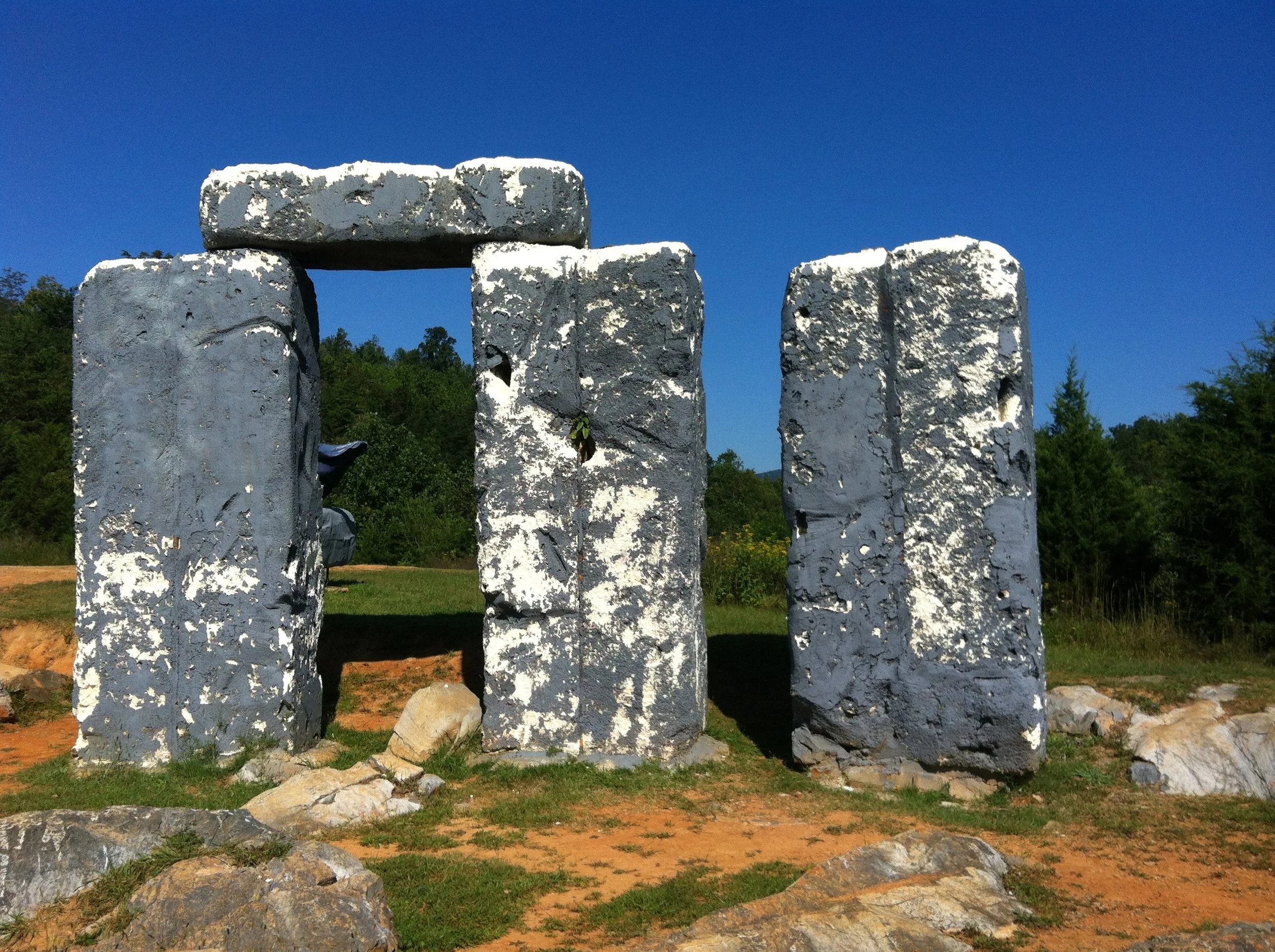
On the way out of town I stopped in at the area’s other attraction, “Foamhenge,” a life-sized reproduction of Stonehenge made out of styrofoam. It looked very realistic, except that in places the grey paint had worn away and you could see the glaring white underneath. It was surrounded by bushes full of yellow flowers and some sort of plant with big, heavy clusters of blood-red seeds. And further distant, grassy fields were scattered with wildflowers and the mountains were green and fading to blue. I realized I was on a plateau, and felt a rush, like I could spread out over the mountains or else run up and down the sides of them through all the depths of tall grass and trees. An impulse to fill all the space described by the sloping curves and undulations of these mountains, and an ache that I couldn’t. Like when you’re about to say something clever and someone cuts you off, or stops listening. Before returning to my car, I took several pictures of Foamhenge with my phone, because I knew that people at home would look at them and grin appreciatively at the joke, and then all I would have to say about my trip was something like, “apparently it’s lined up with the constellations, just like the real one.”